Basic Shapes for Drawing Horror Art (Beginner Guide)
If you’ve ever looked at your drawing and thought, “This looks nothing like what I imagined,” you’re not alone. Most horror art doesn’t start spooky, detailed, or impressive. It usually starts with basic shapes and simple forms.
Circles, ovals, boxes, and cylinders are the foundation of nearly every creepy character you’ll ever draw. Before the teeth, wrinkles, or shadows appear, shapes are doing all the hard work behind the scenes.
Right now, the goal is not to draw something beautiful. The goal is to build structure.
You don’t need fancy tools, perfect lines, or any previous experience to start. A pencil, some paper, and a willingness to make a few weird-looking shapes are more than enough.
1. Why Shapes Matter in Horror Art
Shapes give your drawings stability. They help you understand where things sit in space and how different parts relate to each other.
Using basic shapes helps you:
- Keep heads and bodies proportionate
- Stop features from drifting out of place
- Build characters that feel solid instead of flat
Horror art especially benefits from this because distorted or exaggerated designs still need a believable foundation. Even the weirdest creature needs bones, structure, and balance underneath all the chaos.
2. The Core Shapes You’ll Use Most
You don’t need to memorise dozens of forms. A few simple ones will carry you a long way:
Circles and Ovals

These are your starting points for most things.
Use circles and ovals for:
- Heads
- Eye sockets
- Joints
- Rounded features
Your circles do not need to be perfect. Wobbly shapes are fine. In fact, slightly uneven shapes often feel more organic and unsettling.
Perfect circles are overrated anyway.
Cylinders
Cylinders help give limbs and necks depth.
Use cylinders for:
- Arms and legs
- Necks
- Fingers and toes
Thinking in cylinders helps you avoid flat stick-like limbs and makes your characters feel more three-dimensional.
Boxes

Boxes are excellent for structure.
Use boxes for:
- Torsos
- Jaws
- Pelvis areas
- Any solid, blocky part of a character
Boxes are especially useful in horror art because they give you something stable to distort later. Once the structure is there, you can twist and exaggerate it without everything falling apart.
3. Turning Simple Shapes Into Creepy Forms
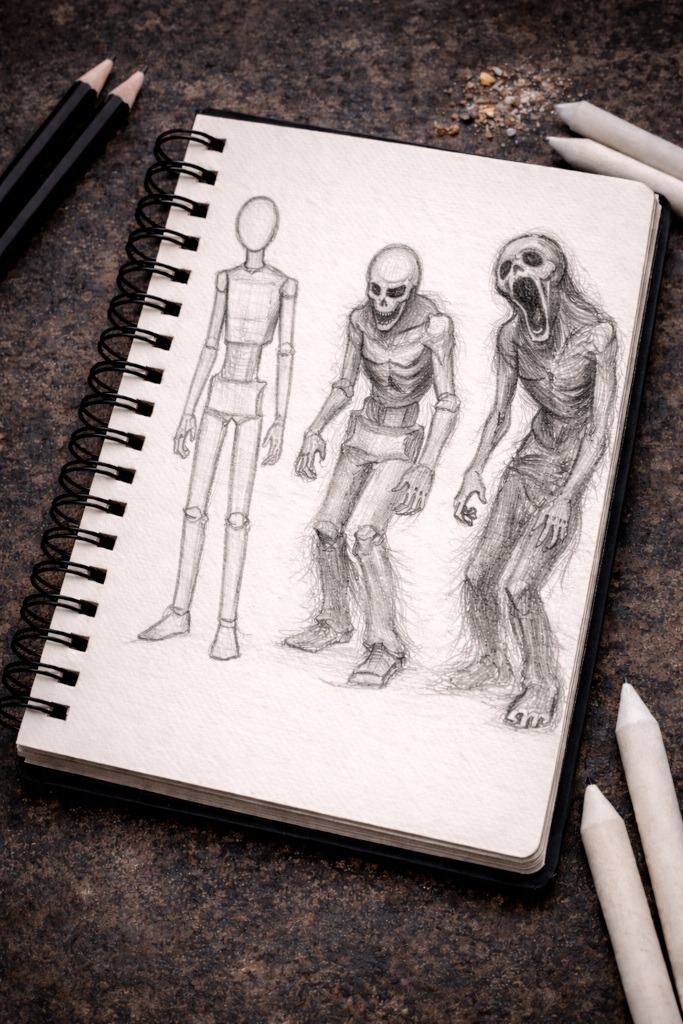
This is where basic shapes stop behaving nicely.
At this stage, you’re not adding details yet. You’re distorting, stretching, tilting, and shifting simple forms to explore mood and unease. Small changes in proportion and posture can completely change how a character feels, even when the shapes themselves stay simple.
Think less about accuracy and more about intent:
- Longer or compressed shapes can feel unnatural
- Tilted forms suggest imbalance or tension
- Uneven posture makes a character feel unsettled or unstable
If your shapes look awkward or “wrong” here, that’s a good sign. Horror thrives on imperfection, and this stage is about discovering unsettling possibilities, not clean results.
You’re building discomfort first. The polish comes later.
A Very Important Reminder for Beginners
Your drawing is not supposed to look good yet.
At this stage, shapes are meant to be:
- Light
- Loose
- Easy to adjust
These are planning lines, not final artwork. If your page looks like a collection of confused blobs, you are doing exactly what you should be doing.
If tools still feel confusing at this stage, I’ve put together a beginner-friendly guide that explains what you actually need (and what you can safely ignore).
👉 Essential Horror Drawing Tools for Beginners
Optional Practice Prompts (No Pressure)
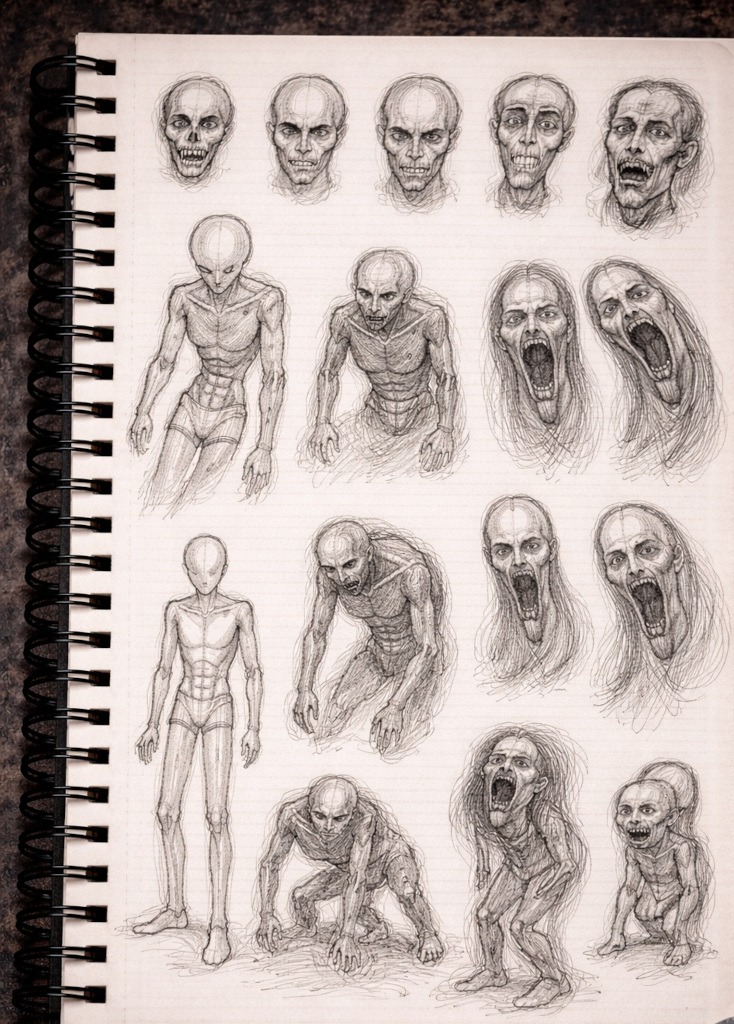
If you’d like to practice without overthinking, try one of these:
- Draw five circles and turn each into a different creepy head shape
- Combine a box and two cylinders to suggest a simple torso and arms
- Take one oval and stretch it into something unsettling
These are short, low-stress exercises. Five minutes is plenty.
Conclusion: Embrace the Blob Stage
Every horror character starts as a rough idea made of basic forms. Before the details, before the shading, and before the creepiness really shows up, there’s a stage where everything looks awkward and unfinished.
That stage is not failure. It’s progress.
Once you’re comfortable building characters from shapes, the next step is learning how to use simple guidelines to place features and keep everything balanced.
For now, keep things light, loose, and imperfect.
The monsters will come later.
What You Learned:
- Complex horror drawings begin with simple shapes
- Circles, ovals, cylinders, and boxes build structure
- Shapes help keep proportions under control
- Messy and uneven shapes are part of the process
What’s Next
Now that you’re getting comfortable using simple shapes, it can help to take a moment to make sure you’ve got the basics covered. These posts will gently support you as you continue building confidence and structure in your horror drawings: