Cryptid Horrors: When Legends Go Rogue
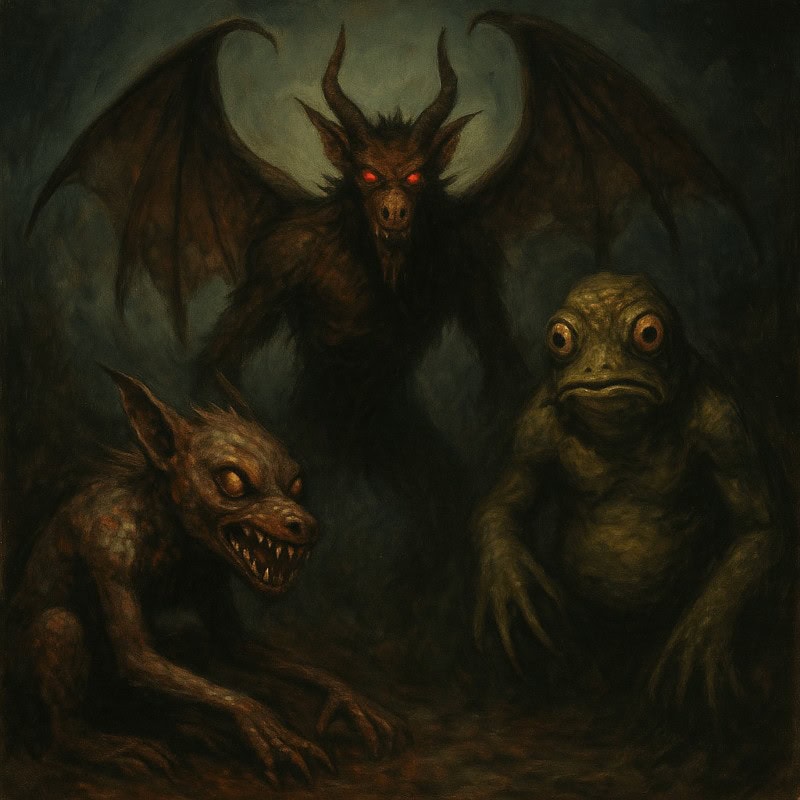
When They Crawl Out of the Shadows…
Welcome to the Cryptid Horrors section – a gallery of winged warnings, fangy freeloaders, and swampy spellcasters. Some don’t even wait for your foggy Tuesday to strike. If you’re looking for inspiration for cryptid horror art, you’ve come to the right place.
These infamous creatures from modern folklore refuse to be forgotten. They haunt small towns, lonely highways, and your nightmares – just waiting to crash your next drawing session.
From Appalachia to the Barrens to boggy riversides, cryptids prove humans are great at inventing monsters (and even better at spotting bumps in the night). Whether real, imagined, or the result of three too many energy drinks, these beasts are here to inspire your darkest sketches. And possibly even make you double-check the shadows behind you.
And hey – if you can’t decide what to draw after this, don’t worry… one of them might just tap you on the shoulder and volunteer.
Meet the Cryptids That Still Roam Among Us:
These creatures didn’t wait around for science to explain them – they just showed up one night and never left. From blood-sucking predators to winged omens and wand-waving weirdos, cryptids represent the ultimate “what if” in folklore.
What if that bump in the night actually has a name?
They’ve haunted quiet woods, lonely highways, and even the occasional suburban backyard, leaving behind just enough evidence (or trauma) to keep the stories alive. Whether you believe they’re real or just very good at hiding, one thing’s certain: they make unforgettable muses for your horror art.
Now let’s meet the creatures that have been lurking in the shadows… patiently waiting for their close-up.
Mothman – The Wings That Foretell Doom
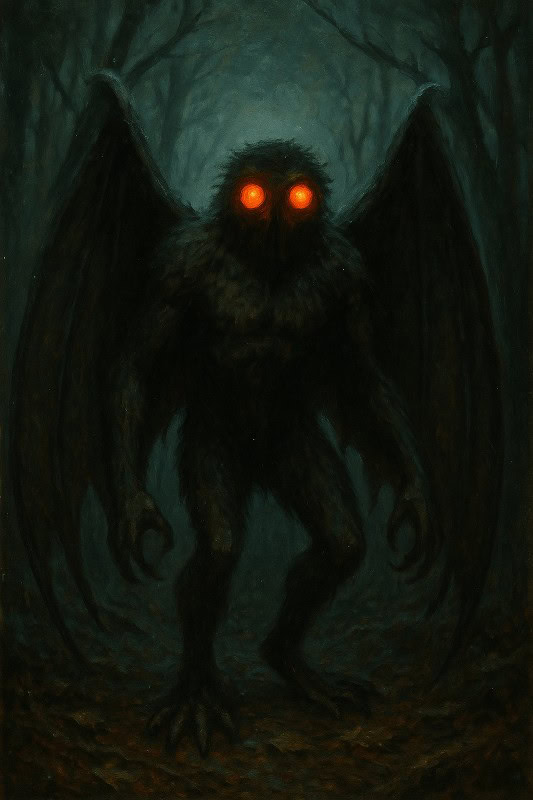
Appalachia’s Winged Prophet of Disaster
Origins & Lore:
The legend of Mothman began in the foggy hollows of Point Pleasant, West Virginia, in November 1966. Two young couples were driving along a desolate road near an abandoned TNT factory when they spotted something impossible. A towering, winged figure – at least seven feet tall – with enormous wings folded behind its back and two glowing red eyes that seemed to pierce the darkness.
Over the next year, dozens of similar sightings were reported in Point Pleasant. Journalist John A. Keel later investigated these strange events, documenting them in his now-famous book The Mothman Prophecies, which helped cement Mothman’s place in modern folklore.
Witnesses described a creature that lifted straight into the air like a helicopter, with wings that sounded like thunder. Then, on December 15th, 1967, the Silver Bridge suddenly and mysteriously collapsed, killing 46 people. After that, the sightings stopped.
Some believe Mothman was a harbinger of disaster – appearing to warn people or perhaps curse the town. Others theorise he’s an alien, a spirit, or even an interdimensional traveller caught in our world. Whatever he is, his brief but chilling appearance left an unforgettable mark on Appalachian folklore – and a strong reminder to always look up when the night feels a little too quiet.
Why He Haunts Appalachia:
Mothman embodies the fear of inevitable tragedy – that quiet, heavy feeling that something terrible is coming and there’s nothing you can do to stop it. He’s not just a monster; he’s a warning.
Every flash of his red eyes reminds you how fragile our world really is. The hills of Appalachia are lonely, fog-covered, and crackling with superstition. In that silence, Mothman veils his sorrow. A watchful figure with wings outstretched, silently looming behind – as if he knows something you don’t.
Art inspiration:
Time to put Mothman on the page – majestic, eerie… and looking like he’s about to land a modelling contract for Gothic Perch magazine, demanding his dramatic close-up like the fog is his personal red carpet.
- Gothic Perch:
Illustrate Mothman perched high atop a bridge, power line, or treetop – his massive wings stretched wide, claiming dominion over the entire sky. An eerie sentinel, watching the world below. - Eyes in the Fog:
Depict his dark, hulking silhouette emerging from thick fog, with nothing visible but his piercing, glowing red eyes burning through the gloom. - Harbinger’s Watch:
Show Mothman looming over scenes of destruction or ruins. Maybe he’s standing on crumbling concrete, surviving a disaster unscathed, exuding the chilling presence of a silent warning. - Mist and Shadow:
Blend his enormous wings into swirling storm clouds or creeping mist, making him look half-formed and otherworldly – like he’s hovering between nightmare and reality. - Winged Dust:
Add haunting details like faint, dusty trails or red-tinted streaks drifting from his wings as he moves, leaving behind an unsettling, almost supernatural residue in the darkened sky.
Chupacabra – The Goat-Sucking Nightmare
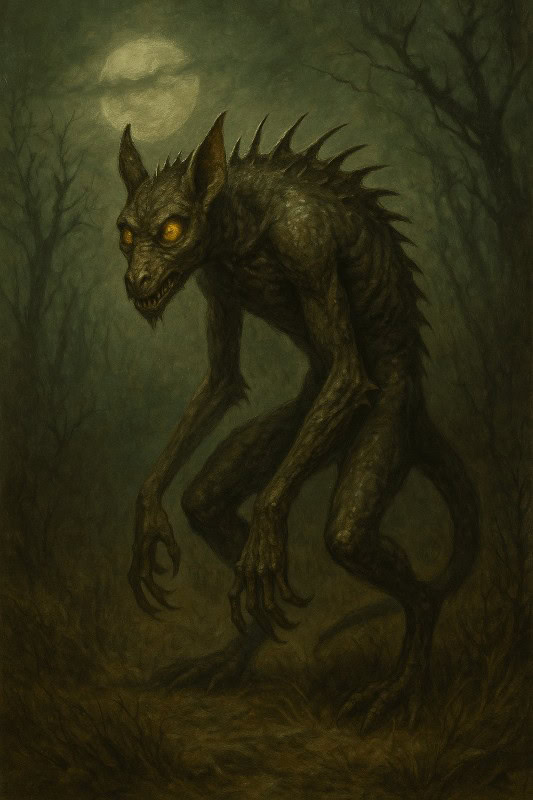
Latin America’s Vampire Vermin
Origins & Lore:
The Chupacabra – which means “goat-sucker” in Spanish – slithered into legend in the 1990s on the island of Puerto Rico. The first widely reported sightings occurred in 1995, when locals began finding their livestock, especially goats, mysteriously dead. Each animal appeared to have been drained of blood, showing puncture wounds on their neck. No tracks. No mess. Just lifeless carcasses with telltale wounds.
Witnesses who claimed to have seen the creature described a reptilian, almost alien-looking predator that was approximately three to four feet tall. It walked on two legs, had spiny ridges down its back, glowing red eyes, and claws sharp enough to make Edward Scissorhands look like a disappointment at a nail salon. Some even said it moved with eerie, unnatural speed and let out high-pitched noises that made the hair on their necks stand up.
Interestingly, some cryptid researchers believe the creature’s appearance was influenced by the 1995 sci-fi horror film Species, which had just been released in Puerto Rico around the time of the first sightings. The film’s alien antagonist shared a similar look – spiky, humanoid, and otherworldly – which has led some to suggest the Chupacabra may be a case of mass media-inspired panic. Scientists, however, largely blame the sightings on mangy coyotes or wild dogs.
Why It Haunts Farms:
The Chupacabra taps into something primal: the fear of being preyed upon when you least expect it. It doesn’t stalk the strong. It drains the helpless, it comes quietly in the night, slipping past fences and locks to take what you hold dear – without ever showing its face.
To farmers, it’s not just a predator but a mystery that can’t be solved. Something more intelligent, more precise, more terrifying than a simple wild animal. And it leaves behind more than dead goats… it leaves behind questions no one really wants answers to.
Even now, farmers still whisper its name on moonlit nights, their voices hushed – afraid it might hear them. Those glowing eyes watching from the edge of the fields? A reminder that not all the mysteries of the night were made to be solved. Some just want your goats.
Art Inspiration:
Now let’s sketch the Chupacabra – bloodthirsty, hair-raising… and clearly wondering if this pose makes its claws look big.
- Crouching Terror:
Show the Chupacabra low to the ground, body coiled and ready to spring, spine raised, and claws digging into the dirt. The perfect predator lurking just out of sight. - Predator’s Gaze:
Focus on its piercing, glowing eyes peering out from a barn doorway or between fence posts, watching the scene with chilling patience from the shadows. - Blood Hunt:
Capture it mid-hunt under a pale moon – jaws wide, sharp teeth gleaming as it closes in on a terrified goat or chicken. - Scaled Horror:
Emphasise its alien quality with leathery, reptilian skin, streaked with dark blood, slime, or a strange iridescence that hints at something not of this world. - Farmyard Carnage:
Paint a desolate, moonlit farmyard littered with lifeless goats, eerie bloodstains across the ground, and the Chupacabra fading back into the shadows. A scene of silent devastation – and slightly aggressive protein acquisition.
Jersey Devil – The Wails from the Pines
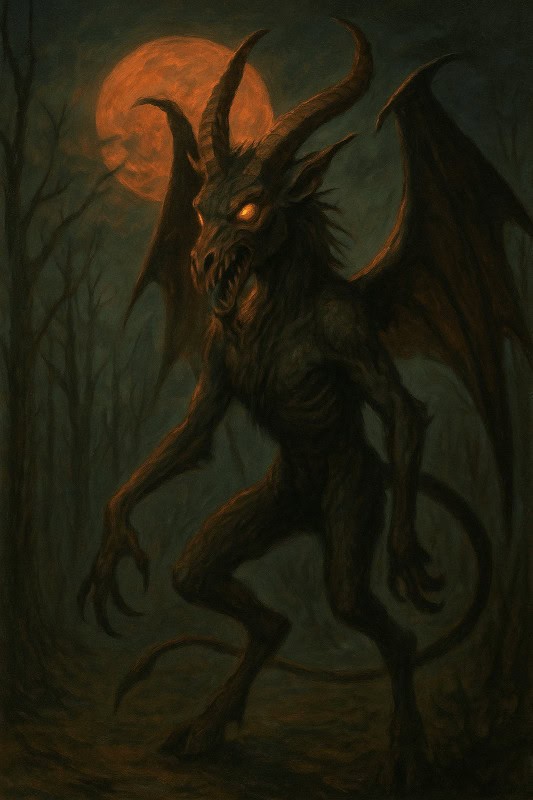
New Jersey’s Favourite Flying Fiend
Origins & Lore:
Born of a curse and steeped in colonial superstition, the Jersey Devil has haunted New Jersey’s Pine Barrens for more than two centuries. According to legend, in 1735, a woman named Mother Leeds – already struggling to care for her twelve children – cried out that her thirteenth child would be the devil himself.
According to the tale, her wish came true. On the stormy night of its birth, the child transformed before her horrified eyes – sprouting leathery wings, clawed hands, a forked tail, and a horse-like head – before letting out an unholy screech and flying up the chimney into the woods.
Since then, the Jersey Devil has been blamed for countless eerie happenings: livestock killed, strange tracks in the snow, piercing shrieks through the night. Reports even claim that Joseph Bonaparte – Napoleon’s brother – saw the creature in the early 1800s.
In 1909, a surge of sightings led to school closures and sparked a media frenzy. Throughout the 1800s and early 1900s, newspapers contributed to a growing sense of fear by reporting on encounters with the beast that terrorised entire towns.
Why It Haunts the Pines:
The Pine Barrens are a place where nature itself feels cursed – and the Jersey Devil is the embodiment of that untamed, uncanny energy. He represents what happens when bitterness, bad luck, and superstition are allowed to fester and take shape.
The forest is his home because the forest, like him, is wild and misunderstood. Full of shadows that don’t want to be named.
Whether demon, cryptid, or cursed child, the Jersey Devil is a monster that won’t let you forget the price of a careless curse. Every eerie cry that echoes through the trees reminds those who hear it that some curses were never meant to be escaped.
Art Inspiration:
Put the Jersey Devil on paper – dripping with menace and that faint smell of hay, like it just left the world’s most cursed petting zoo.
- Wings in the Pines:
Illustrate the Jersey Devil standing ominously in the heart of the Pine Barrens. Its wings stretched wide between gnarled, twisted trees, moonlight casting a chilling silhouette over its monstrous form. - Feral Fury:
Pose the creature rearing up on its hind legs, claws outstretched as if ready to strike. Its bat-like eyes gleaming with wild, predatory rage. - Moonlit Leap:
Capture the moment it vaults across a forest clearing, wings flaring and hooves scraping the earth. An unstoppable blur of feral motion. - Cursed Birth:
Depict its horrifying origin. A faintly human child mid-transformation, limbs twisting, wings sprouting – a cursed soul becoming the legendary beast. - Infernal Mist:
Surround it with glowing smoke and ember-lit mist, giving the impression of an infernal, otherworldly presence rising from the shadows of the woods.
Flatwoods Monster – The Visitor You Don’t Want
West Virginia’s Alien Terror
Origins & Lore:
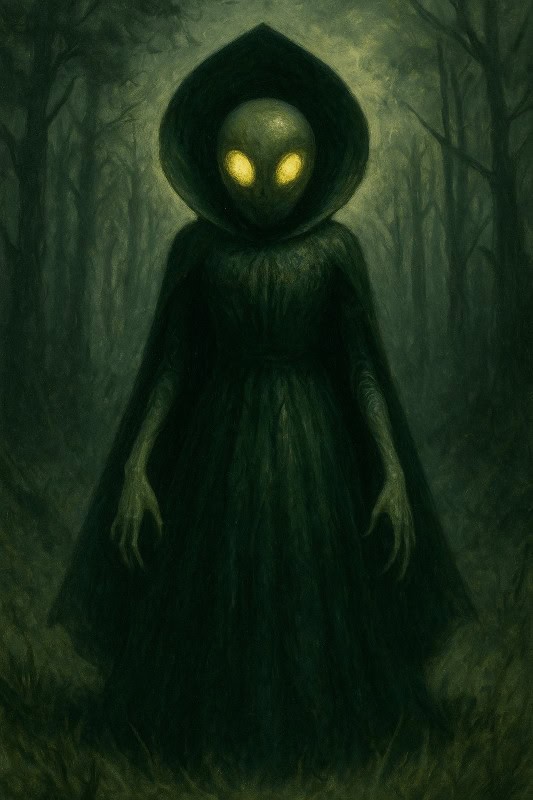
One September evening in 1952, in the small town of Flatwoods, West Virginia, the air shimmered with fear and ozone. Drawn by reports of a blazing fireball streaking across the sky, a group of boys ventured into the hills – and stumbled upon a figure that would terrify them, and generations to come.
They described an eerie, towering figure at least ten feet tall. It had a spade-shaped head, glowing eyes, and a dark, metallic-looking body that glided silently above the ground. Some claimed it hissed. Others said it emitted a strange, choking mist that made them nauseous and dizzy. One person even described the stench of burning metal long after it disappeared.
The U.S Air Force looked into the case as part of Project Blue Book and suggested it may have been a misidentified owl. But to locals, that explanation doesn’t hold up against what they saw.
Why It Haunts Flatwoods:
Some believe the Flatwoods Monster was an alien visitor – possibly the occupant of a crashed UFO. Others dismiss it as mass hysteria fueled by Cold War paranoia. But those who were there swear they felt that night was real… and many still avoid those hills at dusk.
The Flatwoods Monster preys on one of humanity’s oldest fears: the fear of the unknown. Its towering figure and toxic presence remind us that we’re not alone in the universe. Whatever’s out there might not be friendly.
In the dark hills of Flatwoods, where the stars feel just a little too close, the legend lingers as a cautionary tale about poking too far into mysteries we’re not ready to solve.
Art Inspiration:
Time to sketch the Flatwoods Monster. Part close encounter, part “caught mid-gasp when the camera flash went off.”
- Looming Figure:
Illustrate the Flatwoods Monster towering ominously over the treetops, its spade-shaped head glowing faintly as it surveys the dark forest below. - Crash Site Horror:
Show it emerging from a smouldering UFO crash site nestled in the hills, surrounded by twisted metal, glowing lights, and scattered debris. - Fog Walker:
Depict the creature gliding silently down a lonely dirt road, shrouded in thick fog and bathed in an eerie, metallic greenish glow. - Alien Markings:
Add strange, alien-like symbols or markings etched into its skirt-like lower half to emphasise its otherworldly and extraterrestrial nature. - Starborn Nightmare:
Enhance the unsettling alien vibe with glowing auroras shimmering above – or show its dark form dissolving into a starry night sky.
Loveland Frogman – The Wandering Wizard of the River
Ohio’s Amphibian Enigma
Origins & Lore:
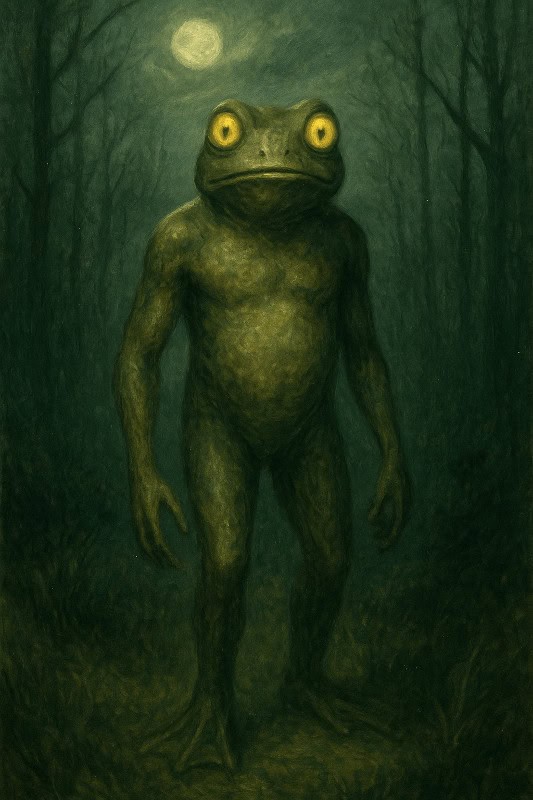
In the quiet, unassuming town of Loveland, Ohio, something strange lurks near the Little Miami River. The first reported sighting came in 1955, when a travelling salesman claimed to have seen three humanoid frog-like creatures on the side of the road late at night. They stood around four feet tall, had leathery amphibious skin and wide, bulging eyes. And one of them, he said, raised a wand-like object that sparked and crackled with light.
For decades, the story remained a local legend. That was until the 1970s, when two police officers on separate occasions also reported seeing the strange creature. The first, Officer Ray Shockey, said the creature ran across the road. The second, Officer Mark Matthews, later claimed it was “just an escaped iguana”… but let’s just say many cryptid fans side-eye that explanation.
Since then, the Loveland Frogman has become a beloved oddity – part of horror and humour. Is it a wizard of the wetlands, a mutant amphibian, or just a prank? No one knows for sure. But locals say if you’re quiet by the river on a foggy night, you might still hear the faint whisper of its spellcasting over the rippling water.
Why It Haunts Loveland:
The Loveland Frogman isn’t scary because he’s vicious. He’s unsettling because he’s almost comical – and still somehow terrifying. He blurs the line between fantasy and nightmare. Wand-casting antics are just human enough to feel wrong.
In the quiet riverbanks and misty bridges of Loveland, he’s a reminder that not every monster hides behind snarls and claws. Some watch you with a grin… and a flicker of strange magic, waiting for you to notice.
Art Inspiration:
Let’s get the Loveland Frogman on paper – before he puts on tiny trousers and becomes impossible to take seriously.
- River Ritual:
Position the Frogman crouched beside a moonlit riverbank, wand raised mid-cast, as a faint magical glow shimmers across the rippling water. Is it casting a spell… or summoning something from below? - Bridge Coven:
Illustrate a trio of Frogmen huddled beneath an old stone bridge, whispering in unison as sparks flicker from their wands. A swampy ritual unfolding in the shadows. - Sinister Smirk:
Zoom in on its wide, unsettling grin and bulbous eyes. Emphasise the eerie tension between its goofy expression and the sense that it knows something you don’t. - Urban Watcher:
Depict the Frogman perched on a sewer grate or moss-covered rock, half-concealed in shadow, watching late-night pedestrians with an unreadable smile. - Swamp Gleam:
Set the scene in dense wetlands, highlighting the creature’s presence with glowing water droplets, slimy reflections, and dark ripples spreading ominously from its hunched form.
Conclusion: Beware What Inspires You
Cryptids are more than campfire stories. They’re walking, slithering metaphors for the unknown – the feared, and sometimes the ridiculous. So, whether you choose to sketch Mothman’s ominous silhouette, the Chupacabra’s spiny back, or the Loveland Frogman’s smug little wand, you’re still keeping these eerie legends alive on paper.
Sharpen your pencils and embrace the weird. And remember: if you ever hear a faint ribbit, flap, or scream outside your window at 3 a.m… don’t worry. It’s probably just your muse. Now, go make something that scares even you.
Related Posts You Might Love (or Fear):
When you’re done tiptoeing through these cryptid tales, keep the eerie inspiration flowing with these posts:
- Designing Cryptids
Want to invent your own creature of nightmares? This guide shows you how to blend anatomy, folklore, and just the right dash of madness to create something uniquely terrifying. - Local Legends
You don’t have to travel far for frights. This post dives into how to uncover spooky stories and urban legends from your own region – perfect for adding a personal, bone-chilling touch to your art.