Dark Fairytales – Nightmare Fuel From the Storybook
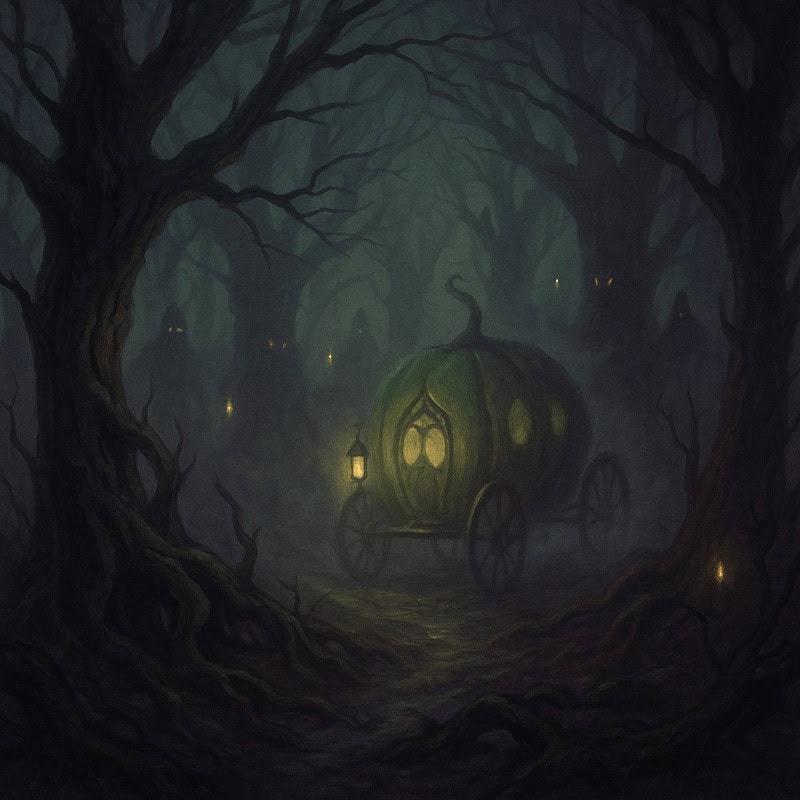
When Once Upon a Time Goes Very, Very Wrong…
Welcome to the Dark Fairytales for horror art inspiration section. Fairytales weren’t always bedtime comfort food. Long before Disney painted them in pastel shades, they were cautionary whispers told by firelight. They were meant to warn, scare, and stay with you. The woods were deep, the wolves were clever, and curiosity often cost more than a little dignity.
These stories didn’t shy away from cruelty. Feet were severed to fit glass slippers, children were abandoned, and queens ordered executions without a blink. They were morality plays dressed in magic and menace. Each one reminded listeners that the world beyond the hearth was as dangerous as it was wondrous.
In horror art, these old tales are a goldmine. They blend the familiar with the uncanny – something beautiful you’ve seen before, but now twisted just enough to make your skin prickle. They’re proof that darkness has always been woven into the fabric of storytelling.
Why Artists Should Draw Dark Fairytales
Fairytales are the original horror stories hiding in plain sight. For artists, they’re a goldmine of symbolism, shadow, and emotional depth. These tales have been retold for centuries. When you draw them in their truest, darkest form, you peel back the sugar coating to reveal the raw fears – vanity, temptation, betrayal, and the monsters within.
Dark fairytales give you a creative license to reimagine beloved characters in haunting ways. You can turn glass slippers into weapons, wolves into men, queens into monsters, and innocence into something far more unsettling. They’re timeless yet personal. As a result, you can channel your own interpretation of fear and beauty in equal measure.
By illustrating dark fairytales, you help keep an ancient storytelling tradition alive. You breathe eerie new life into stories that have shaped cultures for generations. Every line, every shadow, and every bloodstain you draw adds your voice to the endless conversation between myth and morality.
So take your pencil and walk into the woods. Just… don’t stray from the path for too long.
Meet the Dark Fairytale Horrors Hiding in Plain Sight:
These aren’t tales of happily-ever-after. These are the whispers that kept people awake at night – reminders that woods are deep, the wolves are clever, and the price of vanity is steep.
The Bloody Shoes of Cinderella
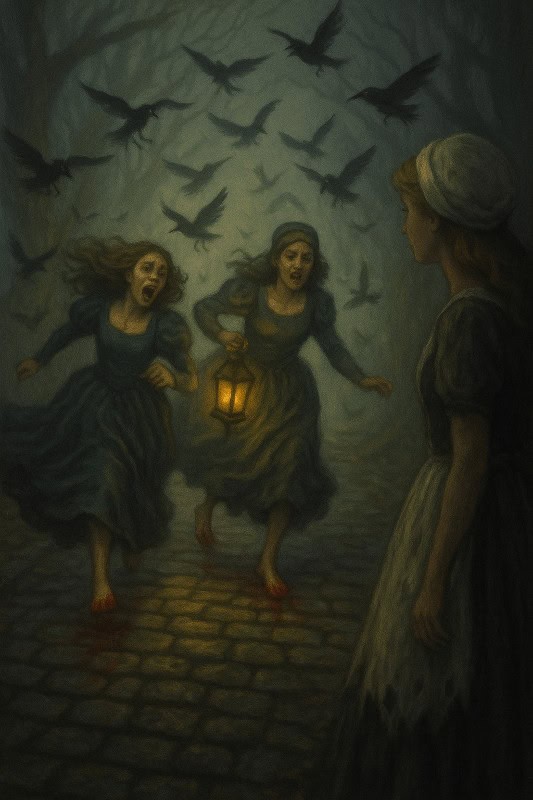
Europe’s Most Grisly Glass Slippers
Origins & Lore:
In the sanitised version, Cinderella slips on a perfect glass slipper and waltzes into her new life. But in the Brothers Grimm tale, her story is far more grotesque and unsettling.
After years of cruelty, the stepsisters became desperate to win the prince’s attention and the privileges of the throne. One sliced off her toes, the other her heel. They both forced their feet into the delicate slipper, staining it with blood as they smiled through the pain.
The tale doesn’t stop at mutilation. As the prince escorts them, birds – believed to be divine messengers of justice – swoop down to peck out the sisters’ eyes. Blinded, they stumble through the darkness. In some tellings, they are cursed to wander sightless for the rest of their lives, a living warning of the dangers of envy and deceit.
Why This Story Still Bleeds Through:
It’s a reminder that even in fairy tales, the pursuit of beauty and power often comes at a terrible, bloody price. Happily ever after is rarely shared by everyone.
Forget glass slippers and pastel gowns. This version of Cinderella is a brutal lesson in what people will endure – and destroy – to get what they want. It’s less “happily ever after” and more “be careful who you trust when ambition is on the line.”
It’s not just about envy, it’s about the unbearable pressure to conform, to be chosen, to be seen as worthy in a world that measures value by perfection. The stepsisters sliced off parts of themselves to fit in. This is more than gore – it’s the grotesque mirror of society that says, “If the shoe doesn’t fit, cut until it does.”
And in the end, Justice isn’t gentle. Blinded and cursed, the stepsisters serve as a chilling reminder that those who claw their way to the top through deceit and vanity often meet a grisly fall. This tale bleeds through history because it’s not just horror for horror’s sake – it’s a warning disguised in a ballgown.
Art Inspiration:
Time to draw Cindarella – before she trades the glass slipper for steel-toe boots and settles things with her stepfamily.
- Blood & Glass:
Illustrate shattered slippers glinting under cold ballroom light, slick with blood. Let shards reflect the horrified faces of background dancers. Make it look as if the magic just broke, and no one knows what to do. - Hollow Beauty:
Capture the stepsisters in the act, faces twisted in pain and jealousy. One grips a knife, the other forces her mutilated foot into the slipper. Their eyes stay locked on the prize while blood pools beneath them. - Symbolic Horror:
Set up a macabre shrine of broken slippers, discarded gauze bandages soaked red, and a cracked mirror reflecting fragmented identities. Beauty, envy, and ruin in one composition. - Corrupted Ball:
Show a once-beautiful ballroom gone nightmarish. A chandelier dripping wax and blood. Feathers and broken heels scatter across the floor, and a trail of crimson footprints leads away from the chaos. - Ghostly Presence:
Let Cinderella stand in the shadows, slightly turned away. Is that a smirk? Pity? Or quiet satisfaction?
(Bonus twist: draw one slipper on her foot, the other left behind – bloody. As if she didn’t escape the horror entirely.)
Little Red Riding Hood – The Wolf Within
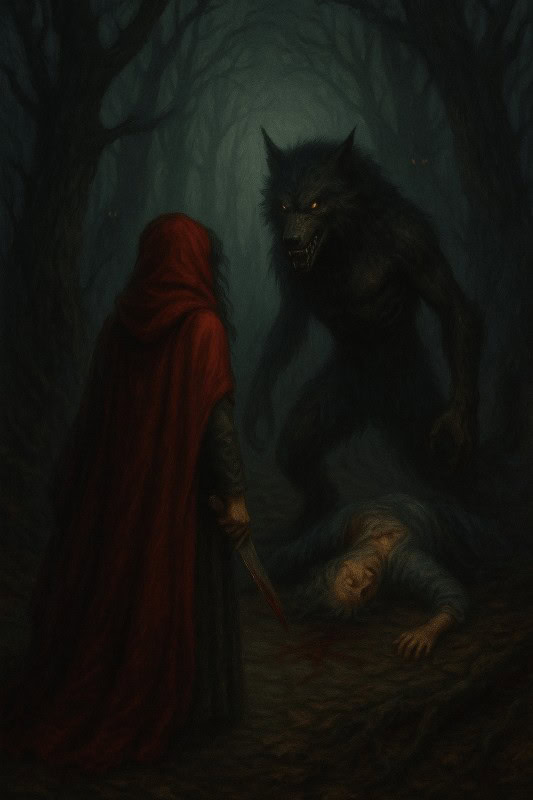
The Predator in the Woods
Origins & Lore:
The earliest versions of Little Red Riding Hood were far more unsettling than the quaint bedtime story we know today. Long before she became the symbol of sweet innocence in a red cloak, Red’s tale was a dark fable of predation, deception, and survival. In some of the oldest French and Italian versions, there was no heroic woodsman to save her. The wolf’s hunger was absolute, and his cunning even crueller. In fact, Charles Perrault’s 1697 version ends with Red being eaten and no rescue in sight – just a moral warning about trusting charming strangers. It was never meant to comfort children, only to caution them.
The wolf didn’t just swallow Granny and the girl. In certain tellings, he served Red pieces of her own grandmother’s flesh and poured her blood to drink, turning the meal into a macabre ritual before devouring her whole. The woods were never a simple backdrop, but a shadowy labyrinth of danger and temptation, where every tree could hide a predator and innocence was nothing but a liability.
Earlier versions made no room for redemption. They stripped away the moral comfort of modern fairytales and offered no rescue – just a lesson carved in fear.
Why This Story Still Haunts Us:
This story isn’t just about a girl and a wolf – it’s about the terrifying moment when innocence meets manipulation. Red’s tale has always been a symbol of vulnerability in the face of cunning cruelty, and of what happens when the safe path is left behind.
The wolf isn’t just a beast in the woods – he’s the charming stranger, the predator in disguise, the danger we’re warned about but never truly prepared for. He wears a smile, speaks in gentle tones, and waits until you’re too close to run. And Red? She’s every person who thinks they’ll be safe if they’re polite, who doubts their gut feeling, who realises the danger a moment too late.
This tale endures because its threat still lurks today – not always with fangs or fur, but in whispers, manipulation, and control. It’s a timeless warning that sometimes the most dangerous creatures are the ones pretending to care.
Art Inspiration:
Sharpen your pencils – Little Red’s here, and she’s just realised grandma’s “nightgown” has suspiciously big claws.
- Wolf in Man’s Clothing:
Draw a tall, shadowy figure merging both human and wolf features – a beast in disguise, with eyes just a little too sharp, claws peeking from tattered gloves, and a grin that doesn’t quite reach the eyes. - Carnivorous Dinner:
Set the scene at an eerie, candlelit table in the woods. Red sits uncertainly, her plate full of something unidentifiable. Across from her, the wolf grins – half-charming, half-horrific. Maybe a second plate is sitting empty… with Grann’s bonnet folded neatly on top of the plate. - Hunter or Prey?:
Red stands over a fallen wolf, axe in hand, face splattered and eyes hollow. Her cloak is torn but glowing red in the moonlight – leaving viewers unsure if she’s been saved… or has become the monster herself. - Symbolic Red:
Let her cloak billow dramatically across the forest floor, pooling like fresh blood. Her face is unreadable, but staring eyes glow faintly from behind nearby trees, suggesting she’s not as alone as she thinks. - Pack Mentality:
Add ghostly wolves watching from the fog behind her – not attacking, but observing. Their stances are eerily still, like she’s being welcomed, not hunted. One could even bow slightly – suggesting she’s now one of them.
Snow White & The Dance of Death
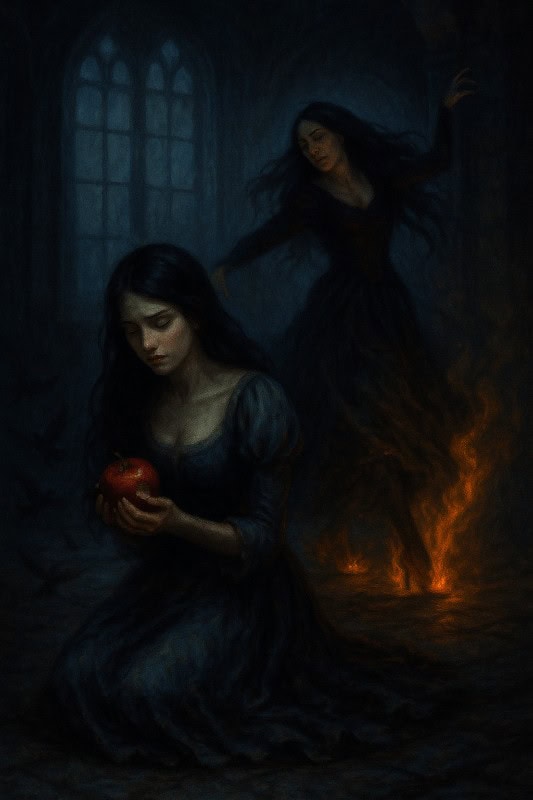
A Box Carried with Malice
Origins & Lore:
Long before a charming prince’s kiss awakened Snow White, her story was a far darker cautionary tale of envy and brutality. In the Brothers Grimm version, her jealous stepmother, consumed by rage at Snow’s growing beauty, ordered a huntsman to kill her in the forest and bring back her lungs and liver as proof. According to some tellings, the queen intended to eat the organs herself, believing she could consume Snow’s youth and innocence in the process.
The huntsman, however, couldn’t bring himself to harm the girl and instead brought back the entrails of a wild animal, which the queen devoured with misplaced satisfaction. Yet Snow’s ordeal didn’t end there. The queen, upon discovering the ruse, hunted her relentlessly with poisoned combs, suffocating bodices, and finally the infamous poisoned apple.
But the most chilling detail came at the end: when her scheme was uncovered, the queen was forced to attend Snow White’s wedding and dance in glowing red-hot iron shoes, burning her feet to blackened stumps as she writhed in pain and collapsed before the assembled guests. Her cruelty was repaid with agony, and the tale left readers with the bitter taste of justice served ice-cold.
This gruesome sequence first appeared in the Grimms’ 1812 edition – a version so brutal it was later softened, but never fully sanitised.
Why This Story Still Chills:
This isn’t just a tale about poisoned apples or love’s true kiss. Snow White’s story warns us of what happens when beauty is idolised, and age becomes a curse. The Queen doesn’t just want Snow gone – she wants to devour her youth, her purity, and her place in the world.
What makes this version truly chilling is that the Queen loses herself in her obsession. Her identity crumbles beneath the weight of comparison, rage, and fear of irrelevance. She becomes something monstrous – willing to commit murder, cannibalism, and psychological torment just to remain adored.
She didn’t just want Snow dead; she wanted the throne, the mirror’s approval, and her youth restored – all at once. Her need to dominate beauty and control innocence becomes something mythic.
And in the end? She’s forced to dance herself to death in burning iron shoes while the world watches. A cruel yet fitting punishment, and a visceral reminder that obsession always outlives satisfaction.
Art Inspiration:
Grab your sketchpad – Snow White’s ready for her portrait, but she’s side-eyeing every piece of fruit in the room.
- Iron Shoes:
Depict the Queen mid-dance, her feet glowing white-hot as smoke coils up her legs, her gown tattered and soaked in sweat and blood. Her face should be frozen between agony and pride – too proud to scream, too broken to stop. - Dark Mirror:
Shatter a mirror across the composition – each shard showing a different distorted version of the Queen’s face: young, old, enraged, hollow-eyed, skeletal. Let the reflections tell her descent. - Snow’s Revenge:
Picture Snow holding the jewelled heart box in one hand, the Queen’s crown dangling loosely from the other. Her expression could be unreadable – not vengeful, not forgiving – just… watching. Maybe the Queen is kneeling before her. - Symbolic Forest:
The woods close in around the Queen as she flees, trees warping into clawed hands or twisted faces, her golden robes dragging like chains behind her. Let the forest become her guilt – inescapable and closing in. - Feast of Vanity:
Paint the Queen seated at a banquet table, surrounded by poisoned fruits and skeletal brides perched unnaturally still on golden platters. A goblet overflows with red wine… or maybe something thicker. The Queen raises it, but her reflection in it shows Snow instead.
The Girl Without Hands
A Deal With the Devil
Origins & Lore:
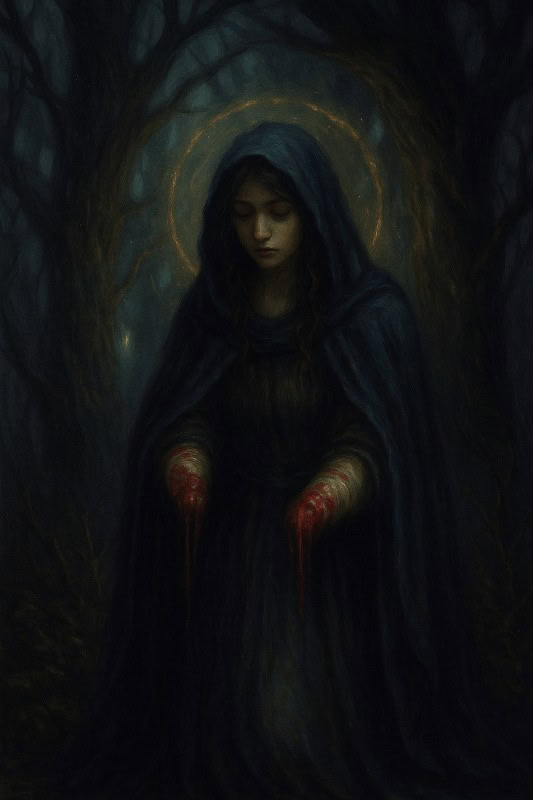
In this haunting and lesser-known Grimm tale, a destitute miller, desperate to improve his lot, makes a reckless bargain with the devil, unknowingly trading away his own daughter in exchange for wealth. When the devil comes to claim her, he demands that she remain pure and untouched so that she can truly belong to him. To save her soul and deny the devil his prize, she places her hands on a chopping block and allows them to be severed, her blood sealing her defiance.
Maimed and heartbroken, she is cast out into the wild. With her stumps wrapped in bandages, she wanders through dark woods and lonely paths, enduring hunger, cold, and the constant threat of predators both human and supernatural. Yet she endures, embodying both fragility and unimaginable strength.
Unlike many fairytales, her survival doesn’t rely on rescue – her inner resolve is what keeps her alive, not enchantments or saviours. Some versions say she eventually finds solace in a distant kingdom, marrying a kind prince and having her hands miraculously restored. Variations of this tale appear throughout Europe – from Italian to Slavic folklore – where hands often represent autonomy, sacrifice, or the price of purity. While the details change, the heart of the story remains the same: a girl stripped of power who survives through strength no curse can claim.
Why This Story Still Haunts Us:
This story lingers because it forces us to confront what it means to endure when everything is taken from you – even your own body. It’s not just a tale of physical loss, but of emotional betrayal, injustice, and the cost of blind ambition. The father’s selfish bargain turns into currency, and his daughter pays the price in blood.
But it’s her defiance that turns the horror into something powerful. She survives abandonment, mutilation, and supernatural threats not through violence, but through unbreakable will. Her severed hands become a symbol of strength rather than weakness – proof that even when you’re stripped of power, you can still reclaim your fate.
In a world that often punishes purity and sacrifices the vulnerable, this tale reminds us that resilience is not quiet submission – it’s survival despite it all. Her story may begin in suffering, but it ends in light, not ruin.
Art Inspiration:
Let’s sketch the Girl Without Hands – before she offers you a handshake you’ll never forget… or understand.
- Shrouded Defiance:
Draw her cloaked in shadows with her bandaged arms raised defiantly, blood seeping through the wrappings. The background can be a dim forest path, with faint glimmers of moonlight catching on her silhouette. - Devil’s Bargain:
A scene showing a demonic figure offering a coin or glowing contract, while a handless girl watches from the shadows – a ghost of her future self reflected in a nearby stream or broken mirror. - Wanderer’s Trial:
Illustrate her limping through the wilderness, bare stumps outstretched, leaving behind faint footprints and smears of blood, while ghostly trees seem to lean in around her. - Symbolic Scene:
Depict a cracked millstone, its surface fractured like shattered bone, with bloody footprints leading through a patch of tangled brambles – a silent tribute to her suffering. - Redemption and Ruin (Split Composition):
On one side: the mutilated girl wrapped in rags, wandering alone under stormy skies. On the other, the same girl reborn in flowing white, her hands either miraculously restored or glowing with divine light, surrounded by blooming trees and hope.
The Juniper Tree
Family Secrets Buried in the Garden
Origins & Lore:
One of the Brothers Grimm’s darkest tales, this story tells of a fractured family torn apart by jealousy and cruelty, making it as haunting as it is gruesome. A kind and loving boy becomes the target of his stepmother’s envy, as she resents the affection his father shows him over her daughter. In a fit of spite, she lures him to a chest under the pretence of offering him an apple. But she then slams the lid shut, breaking his neck and killing him instantly.
To hide her crime, she chops up the boy’s body, cooks it into a thick, savoury stew, and serves it to his unsuspecting father, who praises the meal without knowing he’s eating his own son. Meanwhile, the boy’s little sister, horrified and grief-stricken, gathers her brother’s bones and buries them beneath a juniper tree, where their mother once rested before her death. The Brothers Grimm considered this one of their most beautiful stories – not for its violence, but for the haunting redemption that rises from its grief.
From the juniper tree, a strange and beautiful bird emerges – an enchanted spirit of the murdered boy. Singing a chilling song that recounts his death, the bird collects gifts of gold and justice from villagers before returning home. There, it drops a millstone on the stepmother, killing her instantly, and transforms back into the boy, restored and reunited with his father and sister.
This eerie tale of betrayal, cannibalism, and resurrection is one of the Grimm’s most macabre – a ghost story wrapped in the guise of a family drama.
Why This Story Still Haunts Us:
This tale is not just disturbing – it’s profoundly unsettling because it weaves monstrous horror into the most innocent setting: a family home. There’s no wicked witch in the woods or cursed tower here. Instead, the evil lives in the kitchen, behind the dinner table, and beneath the juniper tree. That’s what makes it so chilling – the horror isn’t far away… It’s already inside.
It haunts us because it tears open the darkest corners of human nature: jealousy, murder, cannibalism, and guilt – and buries them beneath domestic routine. The victim is a child. The killer is his stepmother. And the father, blinded by trust, eats the stew. This is psychological horror at its most twisted.
Yet despite all the blood and grief, the story offers redemption – a rebirth through suffering, where justice comes not from swords or spells, but from memory, music, and poetic vengeance. That eerie bird is more than just a ghost… It’s a voice for the voiceless. And once you’ve heard its song, it’s hard to forget.
Art Inspiration:
Flip open your sketchbook – The Juniper Tree’s bird is about to serve more vengeance than a Shakespearean ghost with Wi-Fi.
- Feathered Vengeance:
Show the ghostly bird perched on a gnarled branch above the house, its beak dripping red. Cast a long shadow over the family home. Hide the shape of a skull in the feathers or leaves. - Stew of Sins:
Create a horrifying kitchen scene – a pot bubbling over a fire, with bones barely visible in the broth and a spoon resting nearby, hinting that someone has just eaten. - Ghost in the Garden:
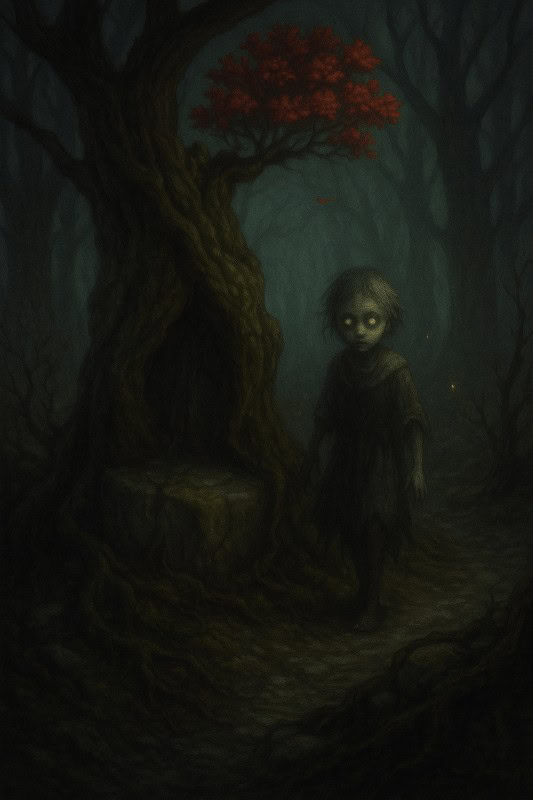
Illustrate a childlike ghost peeking from behind the Juniper Tree, its eyes hollow, its form part smoke, part bone, with petals or feathers drifting around it. - Broken Home:
Show the family seated at the dinner table, smiling… but their faces are cracked like porcelain, and one plate is piled high with something suspiciously meaty. - Cycle of Death:
Depict the boy’s bones entwined with tree roots, the Juniper Tree growing above with a single red flower in bloom, symbolising his rebirth – beautiful, but born from tragedy.
If you enjoy exploring the darker side of storytelling, you might also like my guide to Psychological Horror in Art, where fear comes from suggestion rather than monsters.
Conclusion: Fairytales Were Never Meant to Be Sweet
From darkened ballrooms to shadowy woods, from poisoned apples to burning shoes, fairy tales have always been moral lessons wrapped in horror and beauty. They’re warnings about pride, temptation, and cruelty – and they’ve never stopped being relevant.
Bring dark fairytales to life in your art, and you unearth the bones of stories meant to frighten as much as fascinate. In doing so, you shine a light on the darker corners of human nature. Even the most familiar stories, it turns out, still have teeth – and they bite.
Dark Fairytales Remind Us:
Every happy ending hides a shadow.
Every princess bleeds to wear her crown.
And every wolf still waits at the edge of the path.
So sharpen your pencils, and tell the story the way it was always meant to be told – dark, haunting, and unforgettable… and waiting in the shadows.
Want More Storybook Shivers?
If you enjoyed this unsettling trip through the nightmare versions of fairytales, step deeper into the woods:
- Global Mythology: Nightmares From Every Corner
From banshees to gods of death, mythology bites back. - Greek, Norse & Other Classical Horrors
Discover vengeful gods, cursed wolves, deadly sirens, and more ancient nightmares perfect for your horror art.
There’s always another story waiting to be drawn… and another monster waiting to wake up.