H.R. Giger: The Architect of Beautiful Nightmares
If you’ve ever looked at a horror creature and felt like it was designed with a ruler, a blueprint and a mildly concerning imagination, you’re already circling the world of H.R. Giger.
Most monsters follow a fairly predictable recipe. Add claws. Add teeth. Maybe stretch the limbs a bit. Done. Giger looked at that formula and quietly decided it wasn’t nearly unsettling enough.
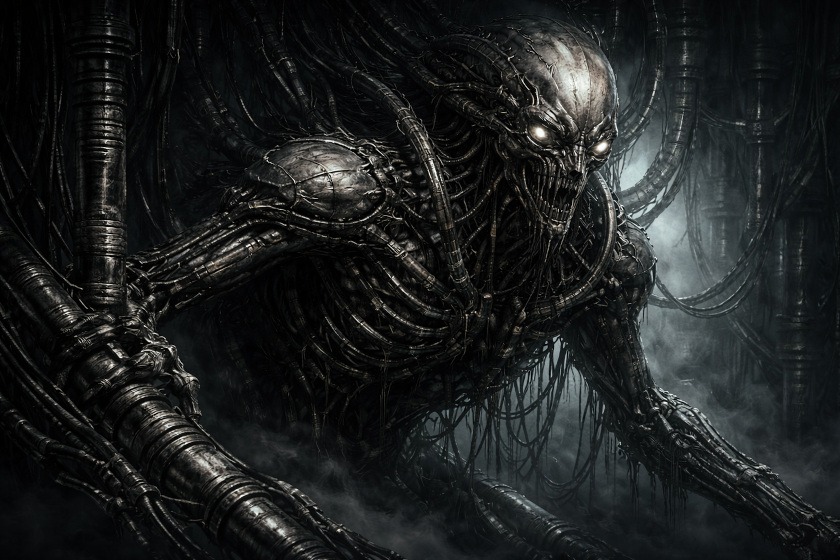
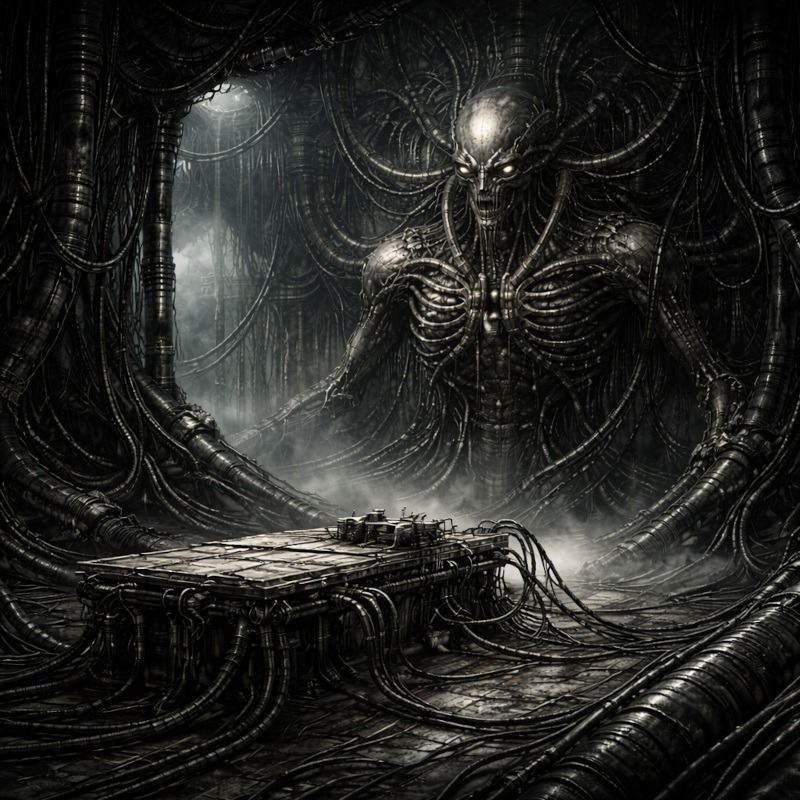
He didn’t just draw creatures. He engineered them. He fused anatomy with machinery so smoothly that your brain cannot quite decide where bone ends and metal begins. And when your brain can’t categorise something properly, it gets uncomfortable. Which is exactly what great horror is supposed to do.
In this post, we are breaking down what made his biomechanical style so powerful, why it reshaped modern horror art, and how you can apply the same ideas in your own drawings without accidentally creating something that looks like it needs charging overnight.
H.R. Giger at a Glance
- Born: 1940, Switzerland
- Died: 2014
- Known for: Biomechanical surrealism
- Famous work: Creature design for Alien
- Signature style: Organic forms fused seamlessly with machinery
- Core themes: Dehumanisation, industrial dread, alienation
- Why he matters: He permanently changed horror creature design
Yes, he’s the reason the Xenomorph exists. Which means he’s also the reason many people distrust suspicious-looking eggs to this day.
Who Was H.R. Giger?
Hans Ruedi Giger was a Swiss artist trained in industrial design and architecture. That background matters. His art feels constructed rather than sketched. There is structure, framework and precision beneath the horror. He didn’t throw shapes at a canvas and hope for the best. He engineered nightmares.
Giger gained worldwide recognition when his painting Necronom IV caught the attention of filmmaker Ridley Scott. That painting became the foundation for the creature in Alien. From that moment on, horror creatures shifted. They became sleeker, more anatomical, more psychologically unsettling, and far less theatrical.
Gone were the rubber suits and exaggerated roaring. In came silence, predatory design and unreadable intent.
The Birth of Biomechanical Horror
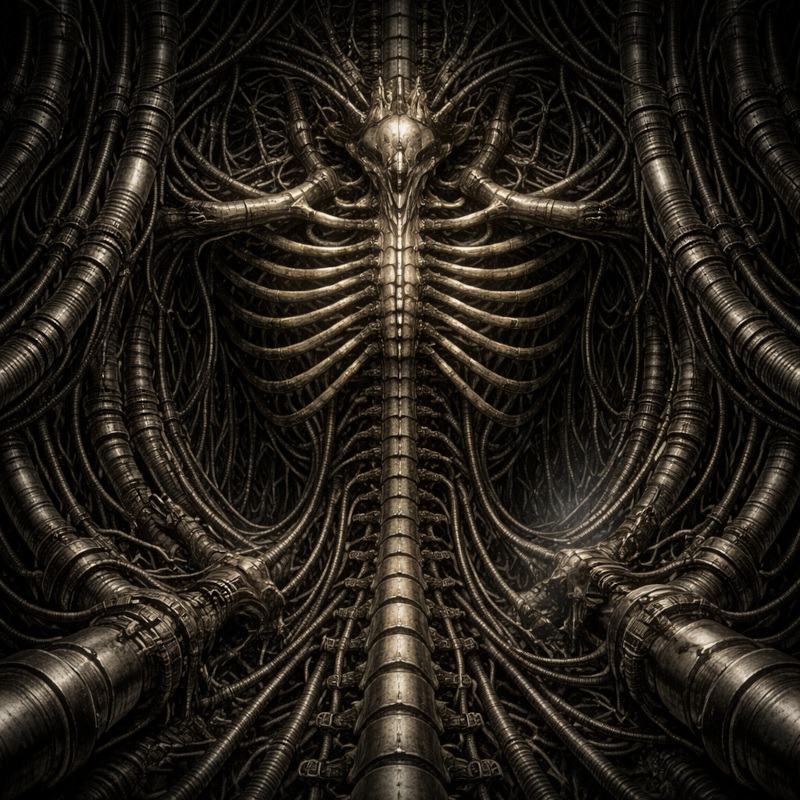
Giger’s style is known as biomechanical art. At its core, this is the fusion of organic forms and mechanical structures. Think bones merging into pistons. Ribcages morphing into architectural frameworks. Tendons blending into cables. Instead of drawing a monster and attaching metal parts like accessories, Giger fused everything so completely that separation felt impossible.
This is unsettling because our brains seek categories. We want to differentiate between what is alive or mechanical, natural or artificial, and safe or dangerous. Giger blurs those distinctions, leaving behind a lingering discomfort.
Biomechanical horror taps into deeper fears: loss of identity, industrialisation, technology overpowering humanity and the idea of being absorbed into something larger and colder. It’s existential dread disguised as creature design.
The Xenomorph: A Creature That Changed Everything
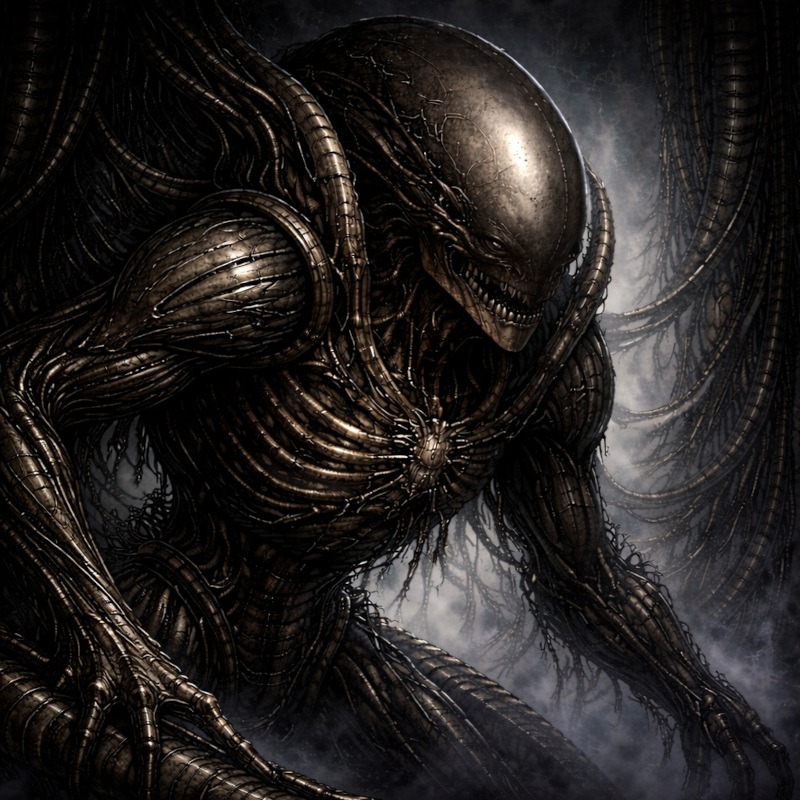
The Xenomorph from Alien remains one of the most iconic horror creatures ever designed. It has no visible eyes, a smooth elongated skull, a skeletal yet muscular body, and an inner jaw that absolutely nobody asked for. Its design is sleek, almost elegant, yet undeniably predatory.
What makes it terrifying is the absence of readable emotion. Humans rely on facial cues to understand intention. The Xenomorph gives you nothing. No eyebrows. No pupils. No emotional signals. Just silence and precision.
That lack of expression makes it unpredictable, and unpredictability creates tension. After Giger, horror creatures evolved. They became less cartoonish and more anatomical. Less loud and more calculated. Modern sci-fi horror owes an enormous debt to that design philosophy.
Why Giger’s Work Feels So Unsettling
One major factor is ambiguity. Often, you can’t immediately identify what you’re looking at. Is that a spine or a series of pipes? Is that a face or part of the environment? That moment of confusion creates unease, and unease lingers longer than shock.
Another factor is his controlled detail. Giger used airbrush techniques to create ultra-smooth gradients and seamless transitions. There are no obvious brushstrokes. Everything looks polished and cold. This removes the sense of “handmade art” and makes the imagery feel grown rather than drawn. And if something looks grown in a biomechanical sense, that’s deeply unsettling.
He also fused vulnerability with machinery. Soft anatomical forms blended with hard industrial surfaces create psychological tension. Your brain struggles to reconcile those opposites. That tension is the discomfort.
His Airbrush Technique and What It Teaches You
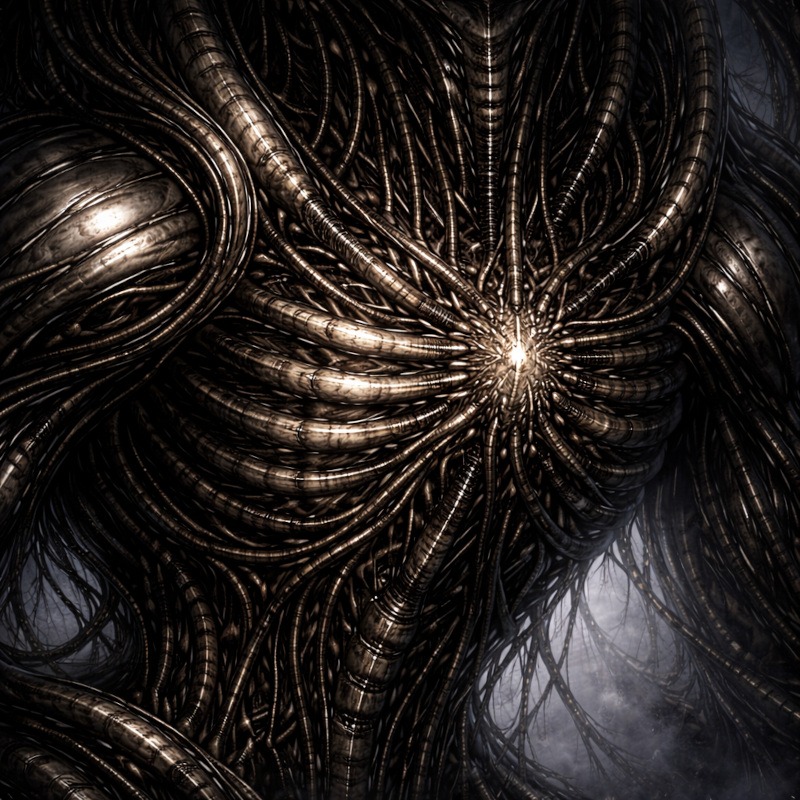
Giger’s mastery of the airbrush allowed him to create metallic surfaces, subtle gradients and atmospheric depth. The smooth blending makes forms appear realistic and integrated.
For your own horror art, this is a powerful lesson. Harsh lines can create aggression, but smooth blending creates realism, and realism makes horror believable. Believable horror lingers.
If you work in pencil, experiment with smoother shading transitions. Blend carefully. Avoid obvious separation between organic and mechanical elements. The more seamless the fusion, the more convincing and unsettling the result will be.
Controversy and Legacy
Giger’s work was not universally accepted. Some viewers found his imagery disturbing beyond traditional horror due to its surreal and anatomical undertones. But boundary-pushing art often shapes the future. Discomfort can drive evolution in visual culture.
He wasn’t interested in safe imagery. He explored subconscious fears and brought them into structured, deliberate form. That boldness is part of why his influence remains strong decades later.
How His Influence Shows Up Today
Giger’s visual language appears throughout modern horror and dark sci-fi. You can see it in industrial environments that feel organic, in creatures with exposed biomechanical structures and in cyberpunk aesthetics that blend flesh and machine.
Even artists who never consciously study him borrow elements of his mood. He proved that horror doesn’t require excessive gore to be effective. Atmosphere, texture and ambiguity can be far more powerful than excess.
What You Can Apply to Your Own Horror Art
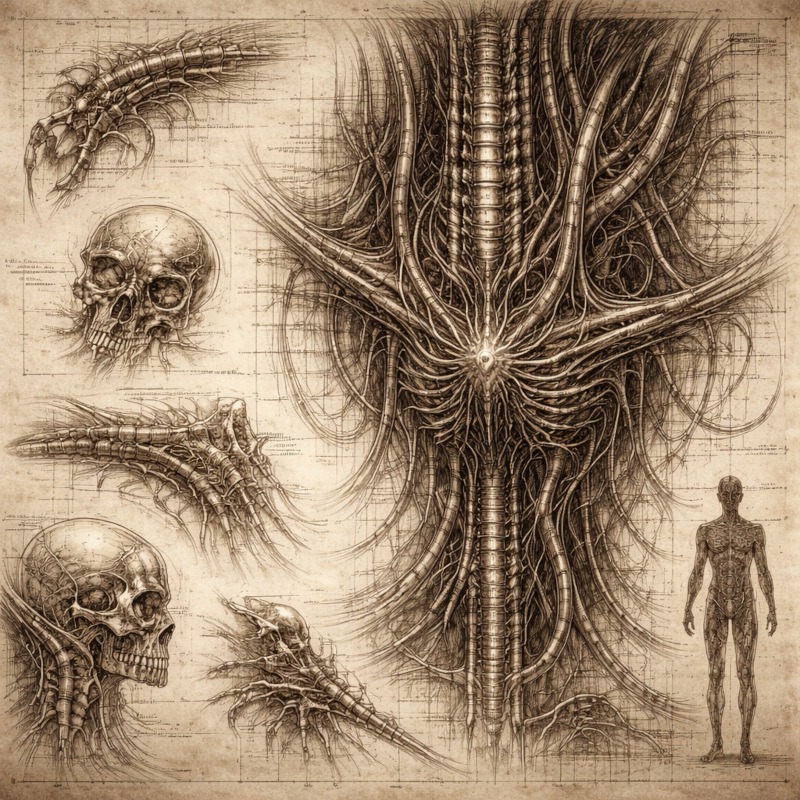
First, experiment with fusion. Take something organic, like a skull or ribcage, and subtly integrate mechanical elements. The key word is subtly. If it looks like you glued a toaster to a skeleton, dial it back.
Second, focus on texture. Cold metal, tensioned cables, smooth bone, and reflective surfaces can all create discomfort when rendered realistically.
Third, remove obvious emotional expression. An unreadable face forces viewers to project their own fear onto the subject.
Finally, think structurally. Build your horror like architecture. Consider framework and layering rather than chaotic additions.
Sketch Exercise: Create Your Own Biomechanical Creature
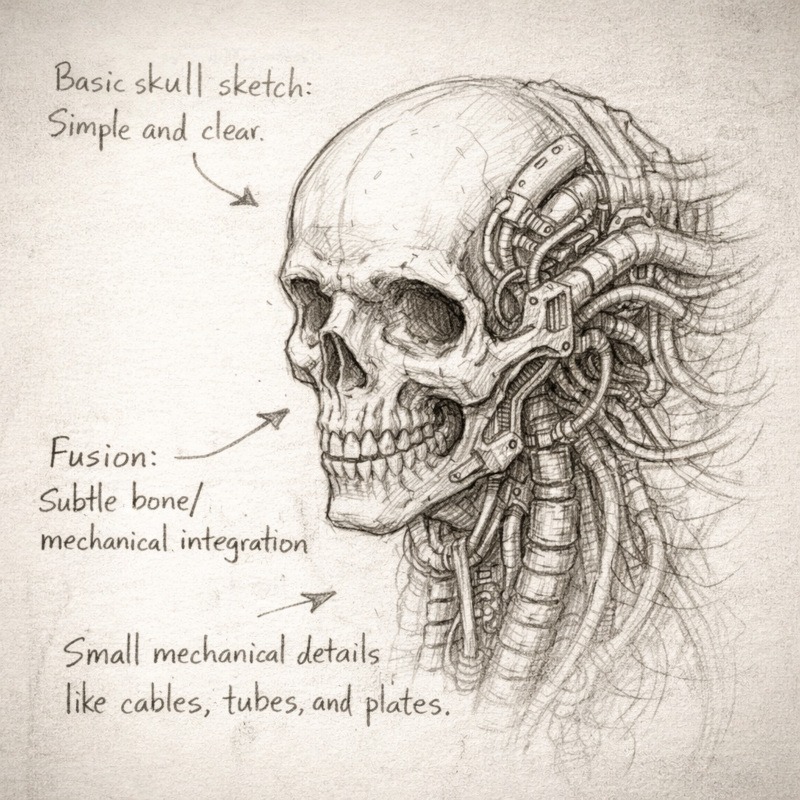
Let’s break this down clearly so you know exactly what to draw:
Step 1: Draw a basic skull shape:
Start with a simple skull in pencil. It does not need to be highly detailed. Focus on the overall head shape, eye sockets and jaw. Keep it clean and easy to read.
Step 2: Choose one area to modify:
Pick one section only, such as the jaw, temple or back of the skull. Leave the rest untouched. The goal is subtle fusion, not “everything is metal now.”
Step 3: Add simple mechanical elements:
Inside your chosen section, draw small mechanical shapes. Think thin pipes, cables, vents, plates or bolts. Keep them simple. You’re blending one mechanical feature into anatomy, not designing a full robot.
Step 4: Make it look fused, not stuck on:
Use smooth shading to blend where bone meets metal. Add shadows so the mechanical parts feel embedded into the skull. Avoid heavy outlines that make the metal look like it was glued on five minutes before submission.
Step 5: Keep the expression neutral:
Don’t exaggerate the face. No screaming skull. No dramatic rage. A calm, unreadable expression often feels far more unsettling.
Step 6: Stop before you overdo it:
Resist the urge to add more and more details. One fused section is often stronger than covering the entire skull with mechanical parts.
When you finish, step back and ask yourself:
Does this feel like bone and metal became one thing?
Or does it look like a skull that tripped over a toolbox?
Adjust from there.
Why Studying Giger Still Matters
Giger’s work remains relevant because it was concept-driven rather than trend-driven. He explored themes of alienation, industrial fear and vulnerability with deliberate structure.
When you study artists like him, you’re not copying style. You’re learning how to construct mood with intention. That is what elevates horror art from a quick spooky sketch to something that lingers in the viewer’s mind long after they have looked away.
If someone looks at your artwork and says, “I don’t know why this makes me uncomfortable, but it really does,” you’ve achieved something powerful.
Conclusion
H.R. Giger proved that horror doesn’t have to shout to be powerful. By blending anatomy with machinery in a structured, deliberate way, he created creatures that feel engineered rather than chaotic. That precision is what makes them so unsettling. They look less like drawings and more like something that could quietly exist in a very well-organised nightmare.
His work shows that discomfort often comes from subtlety. Smooth blending, restrained detail and unreadable expressions can create far more tension than simply adding more spikes and hoping nobody asks questions. When your viewer can’t fully understand what they’re looking at, their imagination does the heavy lifting for you.
If you start thinking about structure, fusion and texture in your own horror art, you will notice a shift. Your designs will feel more intentional and more believable. And if someone looks at your drawing, pauses, and says, “I don’t know why this makes me uneasy,” then congratulations. You have officially moved beyond the “extra teeth” stage.
What You Learned:
- Biomechanical art blends body parts and machine parts so smoothly that they appear as one single form.
- Planning your drawing like a structure or framework makes horror feel more realistic and less messy.
- Creatures look scarier when their faces do not show clear emotions. If you can’t read what they are thinking, they feel more dangerous.
- Smooth shading helps blend organic and mechanical parts together so they look fused instead of stuck on.
- Small mechanical details are often more effective than covering the whole creature in metal parts.
- Textures like smooth metal, bone and cables can make a drawing feel uncomfortable without needing blood or gore.
- Keeping parts of your design simple can make the scary details stand out more.
Continue Exploring Dark & Macabre Art
If Giger’s biomechanical precision fascinated you, explore how other artists shaped horror in completely different ways:
- Zdzisław Beksiński – Painting the Beauty of Desolation
- Junji Ito – The Master of Psychological and Body Horror
Want to understand how these influences shaped modern horror as a whole?
- Famous Horror Artists and Their Influence on Modern Horror Art
- Dark Fantasy vs. Horror Art – Finding Inspiration in the Shadows
Or explore how psychological distortion works in: