Greek, Norse and Other Classical Horrors
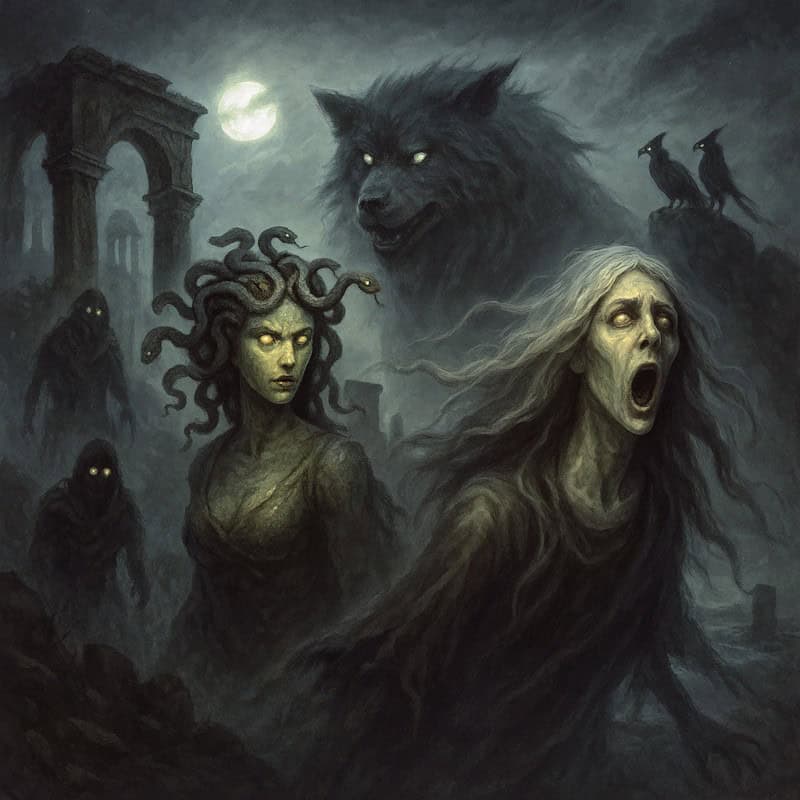
When Myths Crawl into Your Sketchbook…
Before horror movies, haunted houses, and creepy cryptids, humanity had already mastered the art of scaring itself silly. Ancient myths teemed with monsters, curses, and creatures designed to make sure nobody slept easily – and that’s before you even factor in the lack of electric lighting.
These weren’t just bedtime stories or heroic feats. They were cautionary nightmares meant to keep you glancing over your shoulder and possibly checking under your bed with a weapon in hand. From vengeful gods cursing mortals to beasts created purely for punishment, classical mythology overflows with creatures perfect for horror art inspiration.
The best part? These ancient horrors still lurk in our modern imagination, waiting for artists like you to resurrect them (preferably on paper, not in your living room). If you’re tired of drawing the usual vampires and zombies, it’s time to raid the old legends – where the curses are nastier, the survival odds slimmer, and “happy endings” are optimistic at best.
Meet the mythological creatures that inspire horror art:
These aren’t your average ghouls. Every one of these legendary beings carries a story steeped in fear, fate, and the occasional horrifying plot twist. Whether they’re turning heroes to stone, howling omens of death, or guarding the gates of the afterlife with far too many teeth, these myth-born nightmares exist to make mortals regret their life choices.
So, sharpen your pencils and steady your nerves. The creatures below have haunted humanity for centuries, and they’re itching to escape into your next creation. Let’s take a closer look… but maybe not too close.
Medusa – The gorgon with a killer look
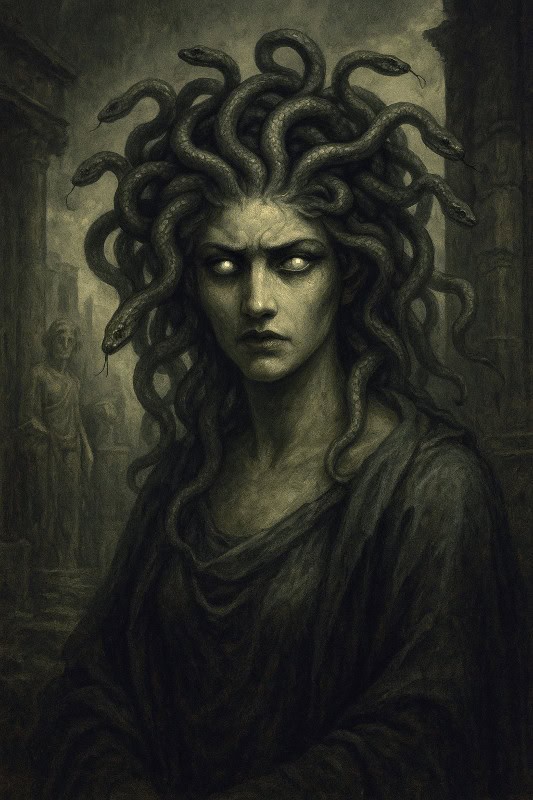
Greek Mythology’s Most Iconic Femme Fatale
Origins & Lore:
Medusa wasn’t always the serpent-haired terror whispered about in myths. She was once a beautiful maiden and devoted priestess of Athena, serving faithfully in the goddess’s temple. She embodied both beauty and piety – but her life took a brutal turn when Poseidon, god of the sea, violated her sanctuary. Instead of punishing him, Athena turned her anger on Medusa, cursing her with hair of venomous serpents and a gaze that turned the living to stone.
What was meant to protect the temple became a grotesque spectacle of divine injustice, leaving Medusa feared and hated for a crime she never chose. Banished from the world she once knew, she wandered in exile, her gaze a weapon against anyone who dared meet her eyes.
Some tales place her on a barren island surrounded by stone statues – each one a victim frozen in terror at the moment they looked upon her. Unlike her immortal Gorgon sisters, Medusa remained mortal, which left her hunted by heroes seeking glory. Eventually, Perseus, guided by Athena, tracked her down and used a mirrored shield to avoid her deadly gaze before striking the fatal blow. Her severed head would go on to serve as both weapon and warning, ending a life steeped in tragedy and vengeance.
Why She Haunted Ancient Greece:
Medusa wasn’t born a monster – she was made into one. Cursed for being a victim, she became a living weapon feared by gods and mortals alike. Her serpent hair and petrifying gaze weren’t just signs of danger; they symbolised injustice in its most brutal form – a woman wronged, transformed, and condemned for it.
To the ancient Greeks, she was more than a cautionary figure. Medusa embodied fear of feminine power, outrage at the desecration of sacred spaces, and the warning that wrath could not always be contained. Her likeness, carved into shields and temples, served as a ward – promising vengeance to anyone who dared overstep.
Even in death, her story didn’t end. Perseus carried her head as a divine weapon, its stony curse still potent. Some myths say her blood gave rise to both venom and healing – poison from one side, salvation from the other. In life and after death, she remained both feared and revered, an eternal paradox in Greek mythology.
Art Inspiration:
Pencils ready – Medusa’s the only model who can turn your art session into a garden ornament display.
- Texture Play:
Contrast her soft, human features with the writhing, scaly serpents in her hair. Use textures – smooth skin, rough scales, the glint of fangs – to heighten the unsettling effect. - Victim Statues:
Fill a haunting forest with her stone victims, frozen mid-scream or mid-motion. Let each statue tell its own silent story of fear, surprise, or betrayal. - Modern Medusa:
Reimagine her in a modern setting – sunglasses shielding others from her deadly gaze, hoodie pulled up, trying to blend in while avoiding accidental petrification. - Emotive Horror:
Show her sorrow and curse side-by-side. Portray the monstrous exterior with subtle hints of sadness and pain. Was she truly evil, or just another victim of cruelty and divine injustice? - Temple of Terror:
Capture the dramatic moment Athena casts the curse – veins darkening, snakes writhing into place, horror and betrayal blooming as she becomes the feared icon.
Medusa remains one of the most iconic mythological creatures in horror art, blending beauty and terror in every depiction.
Draugr – When Vikings just won’t stay dead
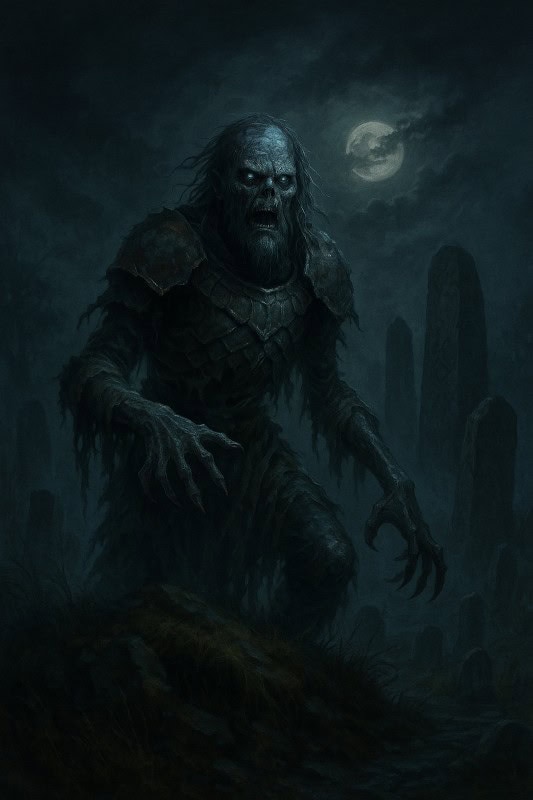
Norse Mythology’s Bloated, Bad-Tempered Revenant
Origins & Lore:
Meeting a draugr was every Viking’s nightmare. These revenants weren’t just guardians of their own grave; they were restless, vengeful, and determined to torment the living. Many tales describe draugr rising from their burial mounds at night to punish those who disrespected their tombs. They could crush livestock in their pens, poison water, and spread disease wherever they roamed.
Unlike ordinary ghosts, draugr were physical creatures, often described as bloated, blackened, and reeking of decay, with strength far beyond that of any man. Some were said to grow larger the longer they were dead, towering over their victims as a monstrous warning of what lay beyond the grave.
In Norse sagas, people took great care to prevent someone from becoming a draugr after death. They tied the corpse’s big toes together, drove iron spikes through it, or burned the body. If those precautions failed, the only sure way to stop a draugr was to drag it out of its mound, cut off its head, burn the remains, and scatter the ashes to the winds. Otherwise, it would rise again, night after night, its hatred unquenched.
Why They Haunted the Norse:
The draugr wasn’t just a ghost – it was a warning in bloated, frostbitten form. In Norse mythology, draugr embodied unresolved grudges, the weight of dishonour, and the terrifying possibility that death doesn’t end vengeance – it just gives it a new body. They weren’t spirits of the innocent, but of the greedy, the jealous, and the wronged – people so bitter in life that even hell didn’t want them.
Unlike peaceful dead who rested in their graves, draugr lashed out when slighted, robbed, or disrespected. They returned with supernatural strength, spreading disease, killing livestock, stomping through village homes, and cracking open tombs. Some grew the longer they lingered, bloating with rot and fury until they no longer resembled the person they once were.
These myths reminded people to live honourably – not just to earn a good death, but to avoid returning as something cursed. If shame and resentment couldn’t silence your anger, you risked coming back as a draugr: a rotting soul in a borrowed body, unstoppable until truly put in the grave.
Art Inspiration:
Grab your sketchpad – the Draugr’s great practice if you’ve ever wanted to draw someone who looks like they lost a fight with the ocean… twice.
- Frostbitten Fury:
Use a cold, eerie palette of icy blues, ashen greys, and faint, deathly purples to capture the look of a body freshly risen from the frozen grave. Add subtle, sickly undertones to hint at decay. - Ancient Armour:
Dress your draugr in decayed Viking relics – rusted chainmail, shattered swords clutched in skeletal hands, and cursed trinkets that tell of plundered treasures. - Grave Mound Atmosphere:
Set the scene in a misty, moonlit burial mound. Let skeletal hands or blue-tinged fingers claw through stone cairns, breaking the silence with an ominous sense of awakening. - Shape-Shifting Terror:
Show a draugr mid-transformation – twisting into a monstrous giant or warping into a smaller, more deceptive form. - Undead Onslaught:
Capture the chaos of an attack: a draugr bursting through a village gate, glowing eyes fixed on prey, its massive frame filling the darkness as terrified villagers scatter. Or place it in a lonely graveyard, unstoppable and vengeful.
Sirens – sweet songs & salty graves
Greek Mythology’s Most Lethal Vocalists
Origins & Lore:
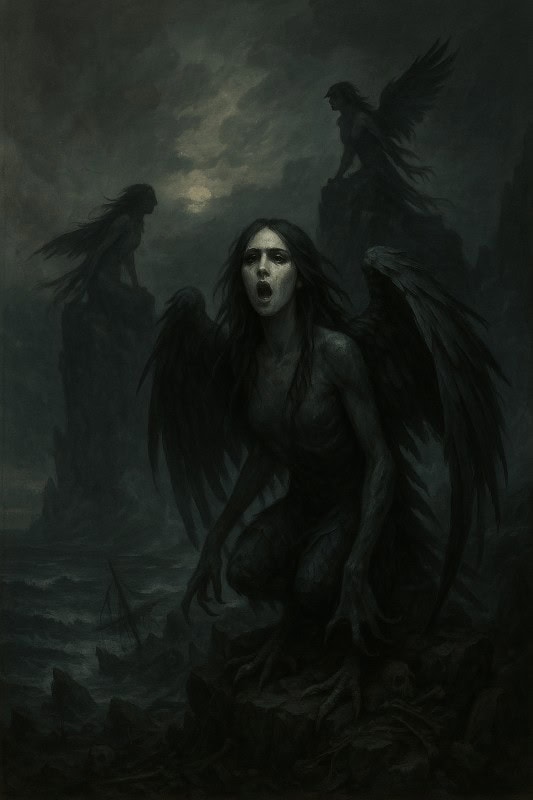
Sirens have lured sailors to their deaths for thousands of years, their legend as deep and dark as the ocean itself. In early Greek mythology, Sirens weren’t just predators – they were tragic figures too. According to some versions of the myth, they were cursed by the gods to remain forever on the rocky shores after failing to save Persephone from abduction. Their songs became a bitter lament, a melody of longing and rage that shattered the minds of anyone who heard it.
Classical writers described them as part-woman, part-bird, perched on jagged cliffs surrounded by the bones of their victims. Later stories reshaped them into mermaid-like forms – beautiful, but just as deadly. Regardless of their form, the result stayed the same: ships smashed to pieces and sailors pulled into the depths.
Some ancient mariners even claimed the sirens would taunt their prey with promises of secrets, knowledge, or lost loved ones before dragging them under. Their songs weren’t just music; they were spells, tailored to the heart of whoever listened, exploiting their deepest desires until nothing mattered.
Why They Haunted Ancient Greece:
Sirens weren’t simply sea-bound seductresses – they were ancient symbols of desire gone wrong. Their haunting voices weren’t only beautiful; they dripped with sorrow, longing, and loss. Some legends say their songs echoed their own grief after failing to save Persephone. Others claim they chose to sing, weaponising sorrow into siren calls that cut straight to the heart of sailors’ deepest regrets.
To the Greeks, the siren was a warning: what you crave might be the thing that destroys you. Whether it was forbidden knowledge, lost love, or a promise of bliss just out of reach, their victims were often doomed long before they saw the rocks. Their allure was psychological as much as supernatural – the sound of temptation made flesh.
These myths left sailors with an uncomfortable question:
“If you heard your heart’s greatest wish whispered from the waves… could you resist looking?”
Spoiler: the answer was usually “nope.”
Art Inspiration:
Pencils out – Sirens are great for gesture drawing, if you can sketch faster than you sink.
- Hybrid Horror:
Emphasise their unsettling bird-woman origins. Sharp talons gripping rocks, feathered wings half-spread in menace. Balance their beauty with human-like faces that mask the danger beneath. - Shipwreck Graves:
Surround your sirens with eerie wreckage – splintered ships and sailors’ bones half-buried in dark, swirling waters. Create an underwater graveyard that whispers of doom. - Song Visuals:
Illustrate the hypnotic magic of their voices. Turn sound into spectral tendrils or swirling notes that coil around the limbs of helpless sailors, dragging them toward their fate. - Contrast Beauty & Death:
Capture them mid-song – radiant and divine – framed by moonlight. Offset this beauty with jagged rocks, shattered ships, and lurking shadows beneath the waves. - Drowned Desires:
Show sailors entranced in the mist, stumbling toward the sirens with glassy eyes. Pale hands reach from the water as they try to drag victims free – or pull them deeper into the fatal temptation.
Fenrir – The wolf that howls at the end of the world
Norse Mythology’s Ultimate Bad Dog
Origins & Lore:
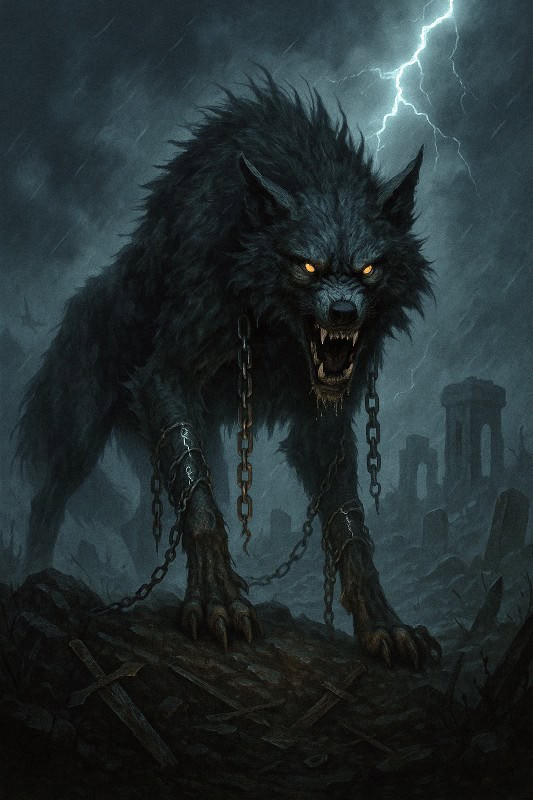
Born of chaos and destined for destruction, Fenrir wasn’t any ordinary wolf. He was one of Loki’s monstrous children, brother to the world serpent Jörmungandr and Hel, queen of the dead. Even as a pup, Fenrir grew at a terrifying rate. Some sagas say he grew so large that his upper jaw scraped the sky while his lower jaw dug into the earth.
Prophecies warned of his role in Ragnarök – breaking free of his chains, devouring Odin, and bringing about the end. Fearing his power, the gods raised him in Asgard under their watch. But none dared approach him except Týr, the only god brave enough to feed and train him.
As Fenrir’s size and strength became unmanageable, the gods tried to bind him with chains of iron. He shattered them with ease. Desperate, they commissioned the dwarves to forge Gleipnir – a magical ribbon made of impossible things: the breath of a fish, the sound of a cat’s foot steps, the roots of a mountain, and more.
Why He Haunted the Norse:
Fenrir wasn’t just a beast to the Norse – he was the embodiment of unstoppable fate. Born from prophecy and raised by his enemies, he became a living shadow on the Norse horizon. If the gods couldn’t contain him, what hope did mortals have?
The gods tricked Fenrir into testing Gleipnir, claiming it was a game. Suspicious, he agreed only if Týr placed his hand in Fenrir’s mouth as a sign of trust. When the ribbon tightened and held fast, Fenrir realised the betrayal and bit down, severing Týr’s hand. Bound at last, Fenrir still burned with rage, and the gods knew the day would come when he’d break free.
Even in chains, Fenrir haunted their dreams – the gaping jaws, the promise of destruction, and the knowledge that some destinies can’t be escaped.
Art Inspiration:
Time to draw – Fenrir’s basically a wolf who heard “sit and stay” and said, “nah, I’ll eat the moon instead”.
- Scale & Power:
Show Fenrir as a massive, unstoppable force. Have him tower over jagged mountains or loom on the horizon, chains snapping like brittle twigs. - Eyes of Fate:
Make his eyes glow with eerie intelligence, aware of the prophecy that dooms the gods. - Apocalyptic Backdrop:
Place him in the chaos of Ragnarök – skies collapsing, seas on fire, and Asgard burning in the distance. - Symbolic Elements:
Add runic carvings to his shackles, or depict Gleipnir as delicate yet unbreakable, mocking the gods’ failed attempts to hold him. - Týr’s Sacrifice:
Capture the moment Týr offers his hand, knowing it will be lost. Show Fenrir watching with narrowed eyes and muscles tensed up.
Banshee – the death whisperer of the Celtic lands
When You Hear Her Scream… It’s Already Too Late
Origins & Lore:
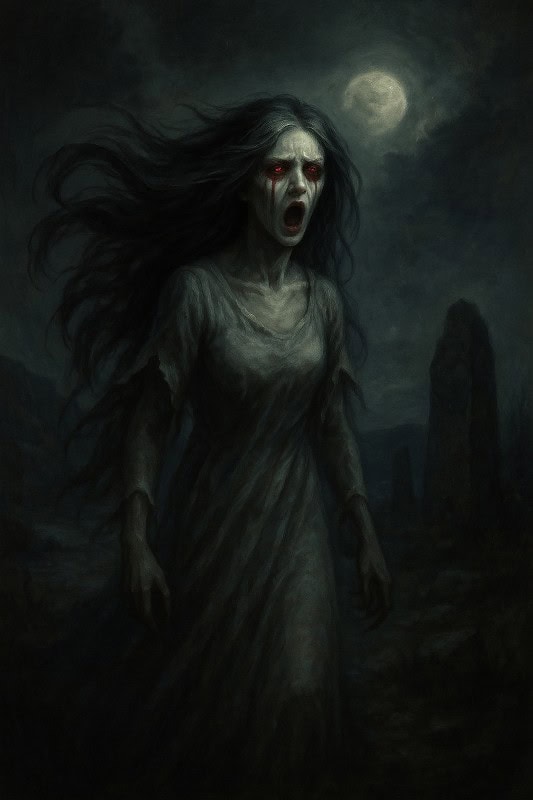
In Irish and Celtic folklore, the banshee (bean sídhe, meaning woman of the fairy mound) wasn’t just a ghost – she was a chilling bridge between the living and the dead. Her wail was said to pierce the night air, a sound no one could mistake.
Some tales tied her to the Aos Si, the fairy folk of the Otherworld, making her a spirit of fate and death. Others claimed she was the restless ghost of a wronged woman, condemned to announce death because of some terrible betrayal in life. Certain families of ancient Irish nobility – like the O’Neills or the O’Briens – believed they had their own family banshee who mourned their dead across generations.
She was also linked to the goddess Morrigan, the Irish deity of war and death, weaving grief through the mortal world as part of an ancient fate. In some versions, she appeared just before someone’s death, her presence an omen that could not be ignored.
Why She Haunted Celtic Lore:
The banshee haunted Celtic lore not with blood or claws, but with inevitability. She didn’t chase her victims – she mourned them before they were even gone. Her cry drifted through the night like a supernatural obituary, blurring the line between life and death.
Her wails weren’t just sounds. Sometimes they were whispers, sighs, or a single note carried on the wind – each one more unsettling than the last. No matter how she appeared or what she sang, her presence meant only one thing: someone’s time was up.
She was feared not for violence, but for certainty. Her voice was a promise that the end was coming, and nothing could stop it. In a world where death was unpredictable and often violent, the Banshee’s song was order wrapped in dread.
Art Inspiration:
Line up your pencils – the Banshee’s perfect if you enjoy drawing while your soul tries to escape through your ears.
- Flowing Horror:
Emphasise the eerie motion of her hair and garments, windswept and torn as if caught in an invisible storm. Let them merge with the dark, misty night sky to heighten the sense of ghostly unrest. - Expression of Sorrow:
Show her face mid-wail – mouth open in a chilling, grief-stricken scream that mixes deep mourning with primal fear. - Ghostly Glow:
Use a muted, cold palette – pale blues, silvery whites, and faint greys – to give her a faint, moonlit luminescence that sets her apart from the surrounding darkness. - Scene Setting:
Place her in a haunting location – a lonely crossroads, the shadowy edge of a forest, or hovering above a quiet cottage. Keep her presence subtle but unmistakable, as if she’s about to freeze viewers with dread. - Silver Comb, Crimson Consequence:
Show her seated by a well or window, brushing her hair with a ghostly silver comb. Her gaze is downcast, her reflection warped in the surface below. Let the comb gleam faintly while a shadowy figure watches in terror.
Hint: In folklore, those who steal or interfere with her comb meet a grisly fate.
Conclusion:
These ancient horrors weren’t just figments of overactive imaginations – they were the shadows lurking in every story, warnings from the darkest corners of human history. From Medusa’s deadly beauty to the Banshee’s sorrowful scream, these legends survived for centuries because fear, like good horror art, is timeless.
So why stick to drawing the usual ghouls when annals of mythology hold a treasure trove of cursed creatures and doom-bringers waiting to be reimagined? From world-ending wolves to ghostly songstresses luring ships to ruin, these myths are begging for a fresh, spooky twist.
Pick up your pencil… but keep one eye on the shadows. Who knows what else might creep in once you invite these legends into your art?
Share your mythological nightmares in the comments or tag Dreaded Designs on social media. Let these mythological creatures fuel your horror art and bring ancient nightmares back to life – one eerie sketch at a time.
Explore more mythological horrors
From whispered legends to monstrous gods, these posts in the Folklore and Mythology in Horror Art series are filled with inspiration for artists who love their muses a little malevolent:
- Yokai & Japanese Spirits: Creepy Muse Fuel for Horror Art
From grinning Tengu to eerie Yokai with a thirst for chaos, dive into the weird and wonderful spirits of Japanese folklore. - Global Mythology – Nightmares from Every Culture
Take a haunting stroll through legendary horrors from around the world – because monsters don’t need passports.