Yokai and Japanese Spirits: Creepy Muse Fuel for Horror Art
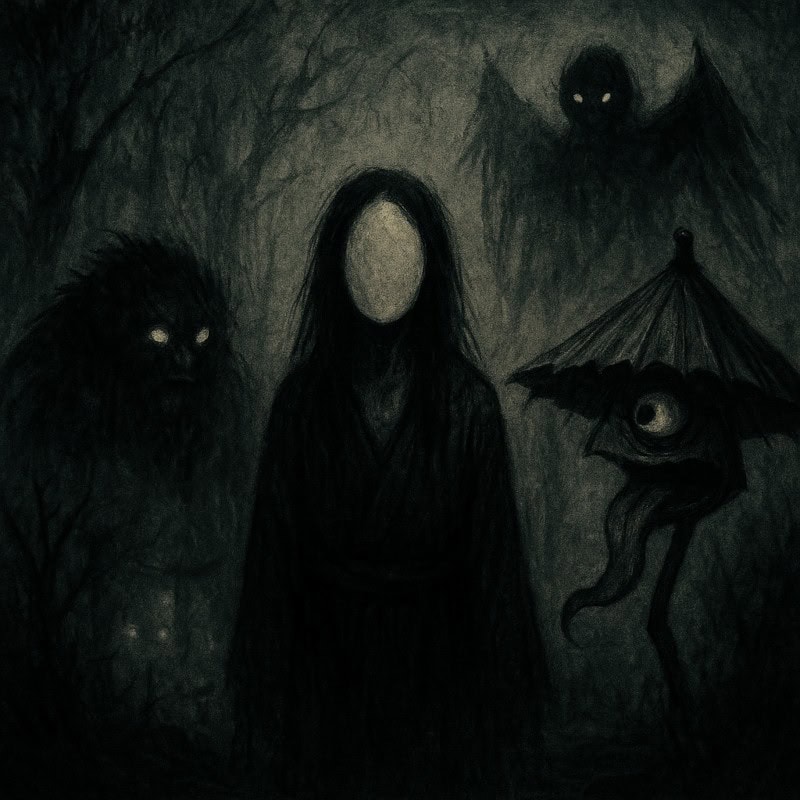
If Your Muse Happens to be a Trickster Spirit…
When you’re hunting for eerie inspiration, yokai in horror art are a goldmine. Japan’s supernatural folklore overflows with beings that can creep, trick, or terrify their way into your sketchbook. These haunted hooligans have spent centuries stealing sandals, licking strangers in the dark, and now… they want you to draw them like one of your French ghosts.
So, if you’re ready to add a dash of eerie unpredictability to your horror art, let’s take a stroll through the shadowy world of yokai – Just don’t wander too far from the path.
What are Yokai?
Yokai (妖怪) are the shapeshifters, pranksters, and nightmare fuel of Japanese folklore. They’re not your average ghost or goblin – yokai can be anything from a faceless spirit to an umbrella with a grudge. Some are harmless tricksters. Others… well, let’s just say they don’t knock before entering your home, or your soul.
These spirits thrive in the in-between spaces: forests, rivers, abandoned villages, or that eerie moment when your reflection lingers a little too long. With origins stretching back to ancient times, yokai blur the line between myth, cautionary tale, and pure creative chaos. Understanding yokai in horror art means embracing the strange, the surreal, and the unsettling.
Famous yokai in horror art:
The world of yokai is vast, weird, and wonderfully terrifying. Here’s a deeper dive into some iconic figures and how to twist them into horror art gold.
Kappa – The deadly gentleman of the swamp
Politeness with a Pulse: The Kappa’s Trickster Legacy
Origins & Lore:
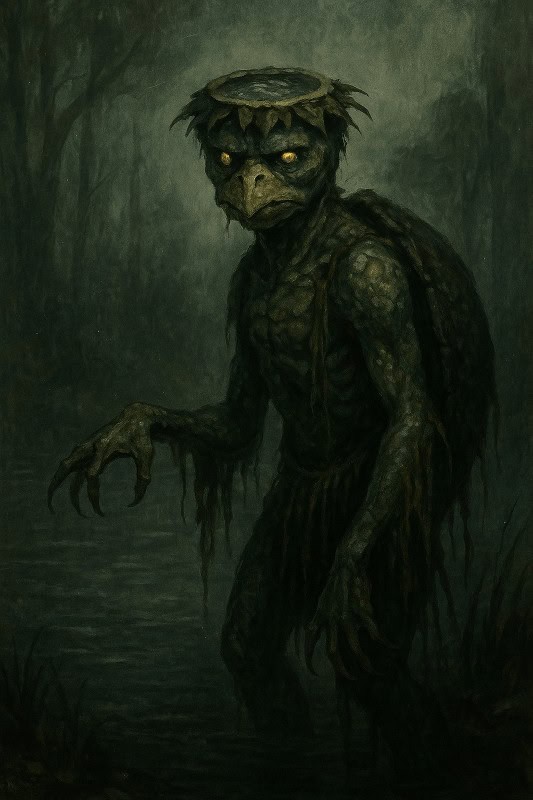
The Kappa is one of Japan’s most enduring yokai – feared, respected, and occasionally bribed with cucumbers. Emerging from Shinto and Buddhist traditions, the Kappa legend mirrors Japan’s deep connection with its rivers and lakes. These creatures weren’t just monsters – they were moral tales made monstrous, created to teach children (and foolish adults) to respect the dangers of water and the spirits said to dwell there.
Often described as child-sized, turtle-shelled amphibians with beaked faces, scaly skin, and a hollow dish on their heads filled with water, Kappa were both absurd and utterly terrifying. That dish, or sara, was the source of their strength – spill it, and the creature would weaken or die. But good luck getting close enough to try.
Despite their unnerving appearance and occasional appetite for… intestines, Kappa were paradoxically polite. According to legend, if you bowed deeply to one, it would feel obliged to return the gesture, spilling its head water in the process and therefore defeating itself.
Still, these swamp-dwelling spirits were nothing to mess with. Kappa were blamed for drownings, mysterious illnesses, livestock attacks, and even the theft of shirikodama – a mythical soul-ball said to reside in the, ahem… nether regions of the body. (yes, they’re cheeky like that.)
Their mischief ranges from pranks to lethal ambushes, making them an unpredictable force in yokai lore. A blend of trickster spirit and watery predator, the Kappa has become one of Japan’s most well-known and weirdly beloved supernatural creatures.
Why it Haunts Rivers:
The Kappa stalks Japan’s rivers and ponds as a cautionary tale wrapped in politeness and slick, webbed menace. It personifies the hidden dangers of water – not just the physical threat of drowning, but also the moral danger of disrespecting nature or tradition. A Kappa doesn’t just drag victims under; it punishes hubris, carelessness, and dishonour, especially in children who wander too close or adults who mock sacred spaces.
Legends say the Kappa represents shame, danger, and duality – a creature that can drown you or help you, depending on how you treat it. In some tales, it heals broken bones, teaches medicine, or helps farmers irrigate their land. In others? It’s the last thing you see before being yanked into a watery grave.
Its eerie civility is part of what makes it so chilling: it bows and waits. Yet behind that politeness lies a monster that clings to grudges and follows ancient customs with unsettling grace.
Art Inspiration:
Get sketching – Kappa pose politely, but you can practically hear them whisper, “Nice ankles.”
- Polite Predator:
Paint a Kappa mid-bow, its posture strangely elegant as water drips from its leafy head bowl. Its eyes should gleam with quiet menace – this is a predator disguised in formality. Let the spilt water subtly foreshadow the moment it loses restraint. - Watery Death Grip:
Illustrate its webbed claws clamped around a struggling child’s ankle beneath the surface, pulling them downward. The water should be murky, with just a glimpse of the Kappa’s eerie smile barely visible through the gloom. - Swamp Court:
Depict multiple Kappa gathered like a yokai tribunal, crouched under moonlight, their shells glistening and expressions coldly amused. Give the scene a tense stillness, as though the forest is holding its breath. - Cucumber Tribute:
Show a riverside lined with cucumbers placed carefully on stones. In the background, faint glowing eyes peer from the dark as the Kappa hungrily accepts the offering. - Dual-Nature Dilemma:
Split the scene vertically. On one side, a helpful Kappa tending to a wounded animal, with a serene riverbank glowing softly behind them. On the other, the same Kappa’s reflection in the water reveals its true face – fangs bared, claws ready, waiting. Let the water act as the portal between kindness and carnage.
Noppera-bō – The faceless ghost that follows you home
You Don’t See the Horror… Until it turns to Face You
Origins & Lore:
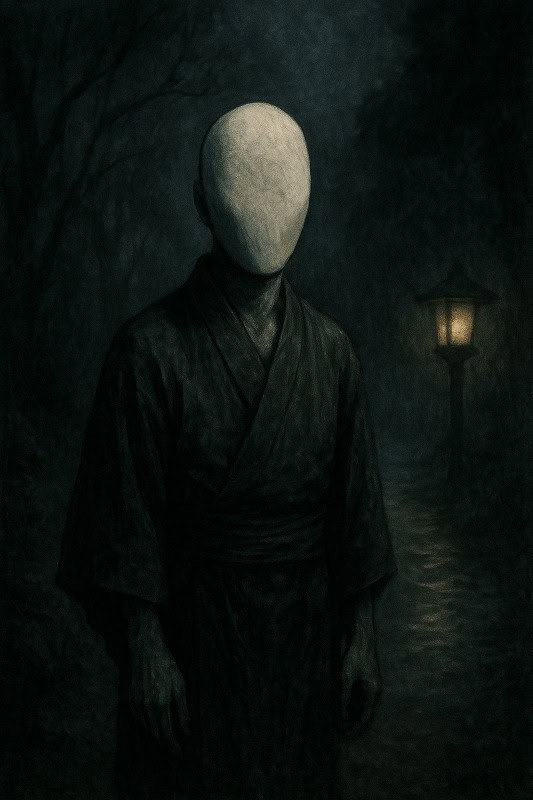
The Noppera-bō, or faceless ghost, is one of Japan’s eeriest yokai – an unnerving spirit that doesn’t shriek, chase, or attack. Instead, it haunts through subtle horror and psychological dread. Its most famous tale comes from the Edo period, about a fisherman who encounters a woman by a river… only for her face to vanish as she turns, smooth and blank like a porcelain mask.
Appearing most often as a solitary figure at night, the Noppera-bō can look like anyone – a friend, a stranger, even a loved one waiting by the roadside. But when they turn to face you, the truth hits too late: something is wrong. Their face is gone, wiped clean of humanity. This terrifying reveal strips the familiar of its comfort, plunging victims into raw existential fear.
While it never physically harms anyone, the Noppera-bō plays a cruel mind game, making you question what’s real, who you can trust, and what might be hiding behind the masks people wear. It’s a master of psychological scare, thriving in quiet streets, lonely walks, and that one shadow just slightly out of place. It doesn’t scream. It simply exists – and that’s what makes it so horrifying.
Why it Haunts Travellers:
The Noppera-bō doesn’t bite or shriek – it haunts through silence and subtlety. It personifies the fear of losing identity and the unsettling idea that even the people closest to us might just be masks. It waits for moments of solitude – an empty road, a midnight riverbank, a familiar face glimpsed in a dream – and then quietly replaces comfort with existential horror.
Its presence unravels reality. One moment you’re walking beside a loved one, the next, they turn to reveal a smooth, featureless void. The Noppera-bō preys on the ordinary, twisting mundane encounters into unforgettable nightmares. The more you try to make sense of it, the more disturbed you feel. It doesn’t just appear – it lingers in your mind, a psychological ghost that follows you home, whispering, “What if the people around you… weren’t?”
Art Inspiration:
Let’s put this nightmare on paper; Noppera-bō are perfect for beginners, because you literally can’t get the facial features wrong.
- Void Stare:
Draw a lone Noppera-bō stepping from the shadows of a side street, its faceless head faintly illuminated by a nearby lantern or vending machine glow. The lack of expression should scream louder than a snarl. - Familiar Stranger:
Illustrate the figure disguised in a comforting form – perhaps a friend or family member mid-turn, their face melting into a smooth void. Capture the sickening realisation just before fear takes over. - Silent Crowd:
Set your scene in a train station or crowded plaza, where every figure is featureless – yet all are staring in unison at the viewer. This mass anonymity creates a feeling of claustrophobic isolation. - Fractured Identity:
Use reflective surfaces – cracked mirrors, puddles, polished windows – to reveal the true blank visage of someone the viewer thought they recognised. The reflection should tell a different story from the subject. - Streetlight Reveal:
Place the figure just outside a single working streetlamp. After the viewer notices it, the shadow reveals a screaming expression that the face itself does not show. Let the contrast do the chilling.
Tengu – The arrogant avian trickster
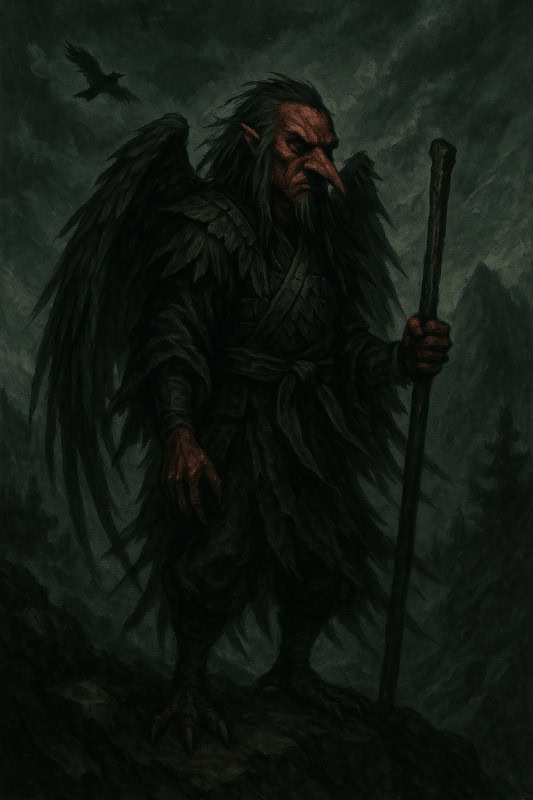
Don’t Laugh too Loud in the Forest… Something up There Might Laugh Back
Origins & Lore:
With crimson faces, hooked noses, and wings that cut through mountain fog, the Tengu are fierce ancient spirits that once embodied the chaos of war in Japan. Feared as demons of destruction, they haunted sacred forests and mountaintops, serving as harbingers of arrogance and agents of punishment when balance was disrupted.
Over time, however, the Tengu evolved. No longer just creatures of wrath, they became unpredictable guardians of wild places, defending nature against human greed and pride. Some appear fully birdlike, soaring with clawed feet and tattered feathers. Others take on more human forms, donning robes or armour, their faces still marked by their infamous beak-like features.
These spirits are as dangerous as they are proud, luring travellers off mountain paths, mocking those who boast, and humbling even the most skilled warriors. Samurai feared and revered them in equal measure, knowing a Tengu could challenge your swordmanship one moment – or toss you off a cliff the next. Trickster, teacher, punisher… the Tengu is a feathered force of nature with no master but the wind.
Why it Haunts the Mountains:
The Tengu is the wind’s wrath made visible – a supernatural slap for anyone who climbs too high on their own ego. These spirits haunt Japan’s misty peaks and sacred slopes, not just to guard the land, but to punish those who defile it with pride, destruction, or ego.
They don’t merely guard sacred forests; they test the hearts of those who intrude. A boastful warrior, a loud traveller, a greedy logger – all become fair game for Tengu mischief or wrath. And when the wind shifts or the forest falls silent, locals say you might already be too deep in their domain.
Tengu aren’t classic villains. They’re reminders that nature has its own code, and those who break it might meet a smirking figure with a wooden beak and a sharp lesson. Their presence is a warning etched into the rocks and carried in the wind: humility is your safest guide in the wild.
Art Inspiration:
Let’s immortalise this weirdo in graphite – wings, attitude, and a nose that could hang the laundry for an entire village.
- Duel in the Mist:
Show a Tengu clashing swords with a samurai, wings unfurled, talons slicing, fog swirling around them. Capture that eerie, mid-battle stillness before the final blow. - Mountain Monarch:
Pose the Tengu high on a cliffside, talons gripping craggy stone, crimson face glaring down at the valley below like a feathery overlord. Let the scale feel dizzying. - Feathered Fury:
Illustrate a full birdlike transformation – beak wide, claws raised, feathers bristling. Capture the tension of a mid-leap or ambush. - Forest Trickster:
Depict the aftermath of their presence: twisted tree roots, a broken mask half-buried in leaves, feathers scattered on a woodland path. No Tengu in sight… but you know it’s watching. - Eyes in the Canopy:
Show the scene from below the forest canopy at dusk – no Tengu in sight, but two glowing eyes pierce through the dense pine needles. Maybe a clawed foot rests on a branch, or a feather floats down. The viewer should feel like prey being watched.
Yuki-onna – The snowstorm siren
When Winter Whispers Your Name, it Might not be the Wind
Origins & Lore:
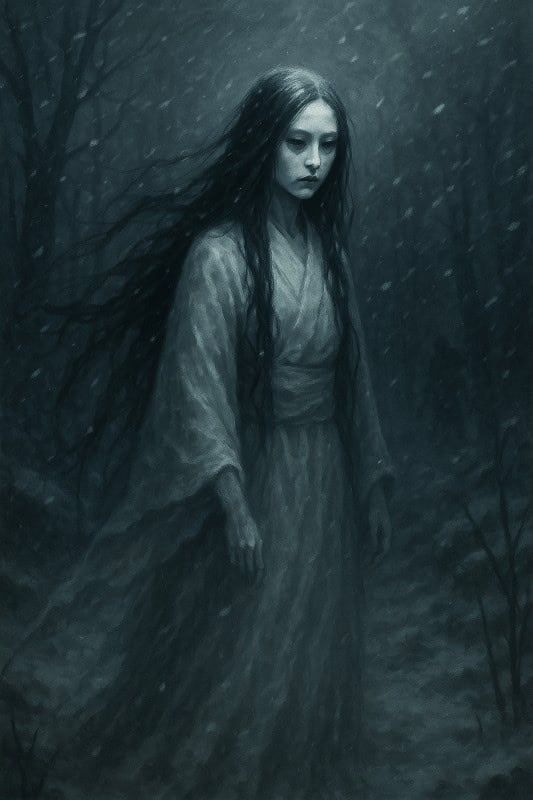
Stories of the Yuki-Onna (literally “Snow Woman”) have haunted Japan’s snowy regions for centuries. With roots in ancient folktales, she is both myth and omen – sometimes a vengeful spirit punishing those who stray into blizzards, other times a tragic soul cursed to wander eternally. Her pale beauty and icy breath disguise a merciless force of nature.
Legends describe her gliding silently through storms, draped in white robes, her long black hair trailing behind like a shadow in snow. Travellers who meet her gaze often freeze – literally – becoming brittle statues in the frozen landscape she haunts. Some say she was once a woman betrayed and left to die in a snowstorm, her rage turned to frost. Others believe she is winter itself, personified and cruel.
Whether she is a killer or a cursed victim, the Yuki-Onna reminds all who hear her tale: warmth is fleeting… and snow holds secrets.
Why She Haunts the Blizzard:
The Yuki-onna is more than a ghost – she’s the bitter whisper of winter itself. A supernatural siren sculpted from ice and sorrow, she haunts snowy mountain paths as a ghostly warning to travellers who cross her domain. Her beauty hides cruelty, and her breath steals warmth. She embodies how kindness can freeze into cruelty when you’re lost and alone in the snow.
Whether she lets you live depends on her mood – or your resemblance to someone she once loved. Her presence is a reminder of nature’s indifference and how fragile our warmth really is.
Art Inspiration:
Get ready to sketch Yuki-onna – half ice princess, half horror story and the reason you’re scared to open the freezer at night.
- Blizzard Phantom:
Draw her silhouette barely visible through the snowstorm, a ghostly shape moving between trees or mountain ridges. Her form should be hauntingly faint, like your last glimpse before the whiteout swallows you. - Frozen Touch:
Show her hand reaching out – slender, ice-blue fingers hovering near a traveller’s cheek or shoulder. Capture the dread of a touch that means death mid-freeze. - Eternal Mourning:
Depict her alone in a snowy forest, head bowed, surrounded by frozen statues – her past victims locked in silent screams. Her long hair should flutter like black ribbons in the wind, curling around sorrowful eyes. - Snow Bride:
Enhance her eerie bridal appearance with forst-encrusted robes and a bitter expression. Her lips drip icicles. Her veil is stiff and glistening. She could be standing by a frozen lake with flowers frozen mid-bloom. - Shatterglass Stare:
Zoom in close: Show her cracked porcelain skin flaking with frost, eyes glazed like shattered glass. Her breath mists in the air, curling into ghostly tendrils. Add snowflakes melting on her lashes and a faint tear turning to ice on her cheek.
Tsukumogami – When your belongings turn against you
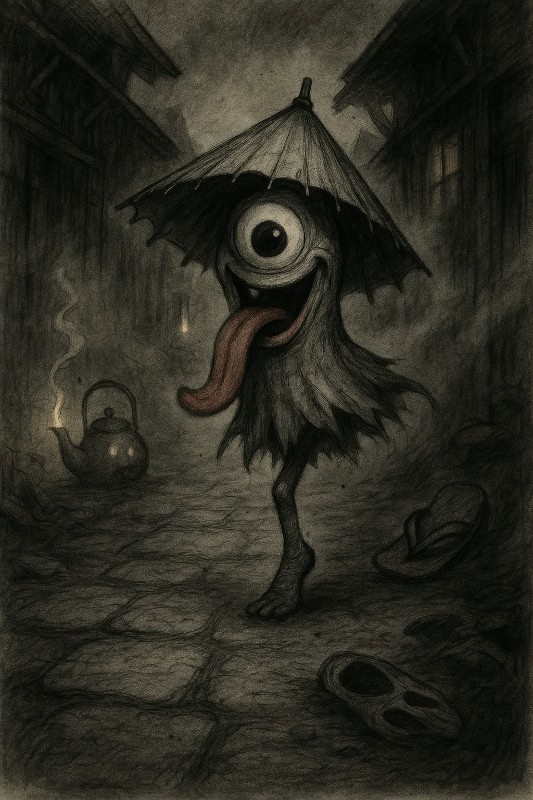
When Your Teapot Starts Glaring at You, it Might be Holding a Grudge
Origins & Lore:
In Japanese folklore, Tsukumogami are ordinary objects that spring to life after a hundred years – especially if they’ve been neglected, mistreated, or thrown out like trash. Fueled by resentment and dusty memories, they transform into quirky, sometimes terrifying spirits. It’s a belief rooted in Shinto animism, where all things – living or not – can possess a spirit. If treated well, these objects remain peaceful. But if discarded or abused? Well… let’s just say your attic might start plotting against you.
One of the most iconic Tsukumogami is the Karakasa-obake – a hopping umbrella yokai with a long tongue, a single glaring eye, and a mischievous streak a mile wide. But it’s not alone. Other possessed objects include sandals with claws, teapots with teeth, or even haunted futons that slither across the floor like centipedes. From playful pranksters to revenge-seeking spirits, Tsukumogami prove that even the forgotten have feelings.
Why It Haunts the Household:
The Tsukumogami is a cautionary tale about respect – especially for the old and overlooked. They whisper that nothing stays forgotten forever – not even that dusty old slipper under your bed. They represent guilt, a cluttered conscience, and the idea that neglect breeds consequences – even in your own home. These spirits haunt us not just with their forms, but with their message: the mundane world is watching.
Japan’s cultural emphasis on respect and ritual runs through these tales – but with a mischievous (and sometimes murderous) twist. That creaky chair in the corner? It might just be clearing its throat before cursing you.
Art Inspiration:
Time to sketch up some furniture with grudges and cutlery with commitment issues.
- Household Horror:
Draw once-ordinary objects twisted by age and resentment – cracked porcelain dolls with glowing eyes, frayed broom bristles curling into claws, or a paper lantern sagging into a sneer. - Cursed Parade:
Imagine a midnight procession of warped belongings marching down an alley. The further back you look, the more monstrous they become – crumpled futons crawling on all fours, rusted alarm clocks with too many teeth, or ink pots dragging trails of dark ooze. - Karakasa-Creep:
Feature the classic umbrella yokai (karakasa-obake) mid-hop, its tongue lolling out and eye glaring wide. Surround it with other animated items – geta sandals with claws, a scarf that slithers like a snake. - Room of Regret:
Illustrate a cluttered attic – objects shoved aside but still watching with glowing eyes. One hangs from the ceiling. One… is standing just behind you. - Grudge-Stitched:
Create a cobbled-together figure made from broken toys, torn fabrics, and forgotten tools – a teapot with button eyes and scissors for arms. Let it drip with both nostalgia and menace.
Conclusion: when folklore crawls into your sketchbook…
Yokai aren’t just relics of ancient stories – they’re living, breathing proof that imagination can twist the ordinary into terrifying shapes. These spirits thrive in cultural shadows, feeding on nightmares, and make perfect creepy companions for horror artists eager to break free from cliché monsters.
Whether you’re just discovering yokai in horror art or already sketching haunted umbrellas, these spirits offer endless inspiration. Their unpredictability, rich symbolism, and eerie charm can transform your art into something that not only looks spooky but feels like it might start moving when you turn your back.
So, why not let a few yokai sneak into your next creation? These spirits are known for getting a little… hands-on. Just don’t be surprised if your pencil develops a mind of its own.
Share your yokai creations in the comments or tag Dreaded Designs on social media – let’s fill the world with beautifully twisted spirits.
Ready to summon even more horror art inspiration?
If your sketchbook is still hungry for nightmares, dive into these haunted highlights from the underworld of folklore:
- Greek, Norse & Other Classical Horrors
Where vengeful gods and mythic monsters still hold a grudge. - Regional Folklore: Nightmares That Call Your Hometown Home
Discover chilling legends lurking in familiar places, where hometown streets hide stories scarier than any fairytale.