Global Mythology – Nightmares from Every Corner
When Legends Refuse to Stay Local…
Welcome to the Global Mythology horror creatures section. A haunted collection of legends from every corner of the world, each one a perfect spark for your next eerie masterpiece.
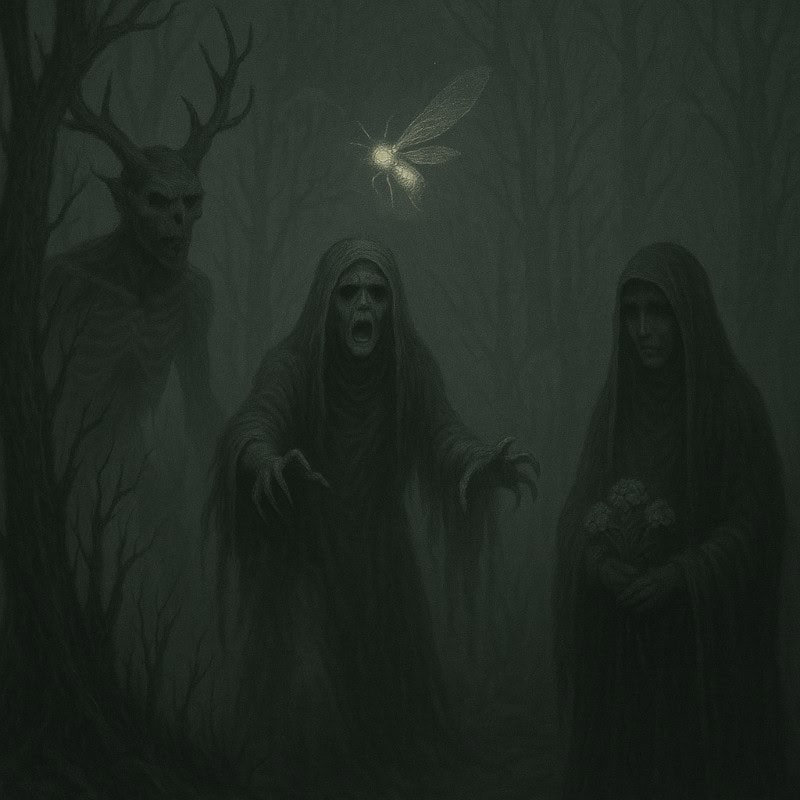
Before Hollywood gave us masked slashers and haunted dolls, the world was already crawling with ancient horrors. From cursed forests in Africa to death-dealing goddesses in South Asia, mythology from around the globe has terrified people for centuries – and it’s brimming with eerie art inspiration.
These beings don’t need special effects – they’re terrifying enough in their original forms. They’re survival guides disguised as nightmares, written by people who saw something horrifying and lived just long enough to spill the tale.
Whether it’s a shape-shifting trickster, a banshee wailing death omens, or a god of death, global mythology is a buffet of terrifying creativity. The best part? Every culture has its own monsters just waiting to be drawn.
Meet the global mythology horror creatures that crossed the continents:
These beings didn’t wait for planes or WI-FI to spread fear. From the deserts of Egypt to the icy winds of the Arctic, ancient spirits have haunted every continent with their own twisted tales.
So sharpen your pencils, channel your inner cryptid, and prepare to sketch what haunts the world after dark.
La Llorona – the wailing woman you don’t want to meet at night
Latin America’s Most Haunted Heartbreak
Origins & lore:
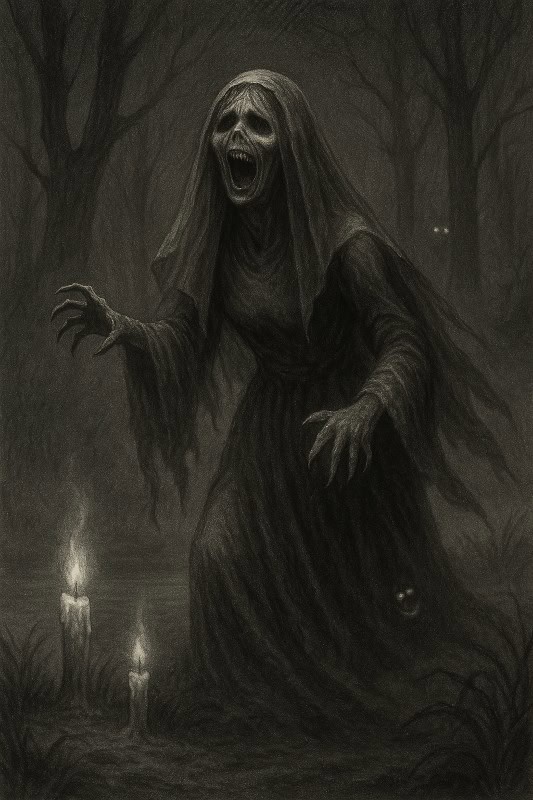
La Llorona, The Weeping Woman, is one of Latin America’s most chilling legends. She’s the ghost of a woman doomed to wander riversides and lonely streets, eternally crying out for her lost children. According to the most common version of the tale, she fell in love with a man who abandoned her for someone else. Consumed by rage and jealousy, she drowned her children in the river, only realising the horror of her actions as their lifeless bodies floated away. Stricken with remorse, she took her own life, but the afterlife showed no mercy.
Cursed for her unspeakable crime, her spirit roams the earth, searching for her children and wailing in the night. Her cries are said to chill the blood and lure the unwary to their deaths. Some versions link her to the Aztec goddess Cihuacóatl, while others see her as a mournful echo of colonial trauma – a mother crying out for all that was taken. Parents once warned children not to stray near rivers after dark. They claimed that La Llorona would mistake them for her own and drag them into the water to share her fate.
Some say her story has pre-Columbian roots, linked to Aztec myths of a weeping goddess who foretold doom. Over time, her tale has evolved into a potent cultural warning. A dark reminder of how love, betrayal, and despair can twist into tragedy. Whether she’s a cautionary spirit, a tragic figure, or a vengeful phantom, one thing remains constant: you don’t want to hear her cry at 3 a.m.
Why she haunts Latin America:
La Llorona’s legend lingers like mist over the water – a ghost soaked in sorrow, guilt, and cultural memory. She isn’t just a tragic figure from the past; she’s a living warning passed down through generations. Her cries echo through lullabies, cautionary tales, and whispered threats to unruly children. She’s the chilling embodiment of a mother’s regret… and a society’s unease with grief that turns destructive.
Some say her roots stretch back to pre-Columbian goddesses of mourning and vengeance, blending ancient myth with colonial trauma. Others see her as a symbol of how heartbreak and betrayal can poison even the purest love. She reminds us that emotions left unresolved, especially guilt, don’t die quietly. They scream.
Whether she’s a restless soul, a warning spirit, or the weeping shadow of societal trauma, La Llorona endures because she taps into something primal: the fear of loss, the horror of consequence, and the idea that sometimes, no apology can undo what’s been done.
And if you hear her crying in the night… It’s already too late to run.
Art inspiration:
If your La Llorona art doesn’t make people feel like they need a life jacket, you’re doing it wrong.
- Gothic Glamour:
Draw La Llorona in a tattered gown, trailing behind her in tatters soaked with river water. Her hair should be long, matted, and flowing like black ink, with strands sticking to her face as if windblown by sorrow. - Emotion Overload:
Focus on her scream – not just open-mouthed, but distorted by grief. Her face partially hidden by her hair or hands, eyes glowing faintly through tears. - Watery Wraith:
Surround her with river effects – drips, ripples, and mirrored reflections. Her form should look like it’s dissolving into the river, as if she’s more mist than woman, barely tethered to the world. - Victim or Villain?:
Reimagine her from a different angle – perhaps sitting by the water’s edge, cradling a phantom child. Is she a monster, or a mother who can’t let go? Leave it to the viewer to decide. - Symbolic Details:
Add elements like children’s shoes floating downstream, broken rosaries tangled in her gown, or distant candlelight on the river – all subtle nods to her story’s lingering presence.
La Llorona is the perfect storm of beauty, sorrow, and supernatural dread – a spirit whose pain echoes through centuries. Whether you draw her as a sorrow-drenched wraith or a wrathful river goddess, she’ll haunt your sketchbook in the best way possible.
Wendigo – the hunger that never dies
Native North America’s Most Famished Fiend
Origins & lore:
The Wendigo crawls out of Algonquian folklore as the ultimate cautionary tale against greed, gluttony, and cannibalism. This emaciated creature was once human – until it tasted human flesh during a brutal winter famine. Transformed into a ravenous monster cursed with eternal hunger, it’s a chilling reminder of what desperation can do when morality freezes over.
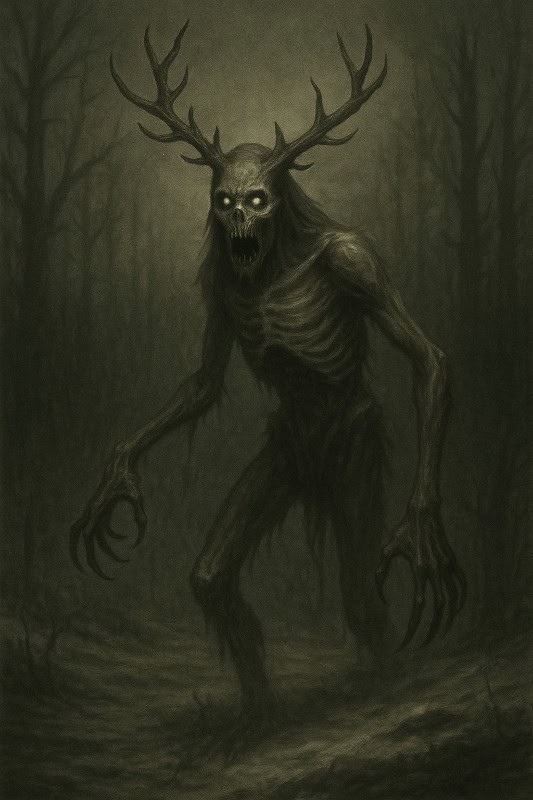
Some traditions describe the Wendigo as impossibly tall and skeletal, towering over the trees. Its glowing eyes, clawed hands, and lipless mouth stretch wide in an eternal scream. Its heart, legend says, is made of solid ice, and its very presence brings biting winds and storms, chilling the air around it.
According to elders’ tales, the Wendigo doesn’t just hunt its prey. It whispers to them, planting the idea of cannibalism in the minds of starving humans, luring them to commit the same taboo that cursed it in the first place. Those who give in to its whispers and consume the flesh of another risk becoming Wendigos themselves, continuing the cycle of hunger and horror.
Why it haunts the north:
While pop culture often paints it as an antlered beast, the original Wendigo was far more human – a gaunt, cursed figure twisted by starvation and sin. Rooted in Algonquian teachings, it warns about balance, taboo, and spiritual corruption.
It’s said to roam the snowy forests, gaunt and skeletal, leaving strange tracks in the snow. It cries like a winter storm warning, striking terror into even the most seasoned hunters.
The Wendigo doesn’t just haunt the woods – it haunts the human condition. More than a monster, it’s the embodiment of famine, greed, and desperation. Born from hunger so deep it twists the soul, it represents the terrifying point where survival turns into savagery.
It’s said to whisper into the minds of the starving, urging them to do the unthinkable. That’s what makes it so chilling – it’s not just out there, stalking the treetops. It’s inside you, lurking behind your cravings, your isolation, your fear of never having enough.
It thrives in places where winter bites hardest, where the silence is broken only by howling winds… or something worse. And in that silence, the Wendigo walks. Gaunt, skeletal, hungry. Always hungry. Its legend warns us what happens when we give in to our darkest urges.
So whether you’re gathered around a campfire or trekking alone through the woods, remember: some appetites were never meant to be fed.
Art inspiration:
Bring the Wendigo to life – creepy, skeletal… and clearly auditioning for America’s Next Top Haunted Forest Resident.
- Bone & Ice Aesthetic:
Sketch a skeletal creature rising from the snow like it’s made of frostbitten branches. Its antlers stretch like twisted trees, ribs poking through pale skin, and frozen breath curling from an ever-snarling mouth. - Starving Horror:
Emphasise the unnatural anatomy – impossibly long limbs, bloated belly despite a starved body, and a face caught in a scream of eternal hunger. Its frame should look like it’s collapsing under its own cursed weight. - Possessed Human:
Design a Wendigo mid-transformation – a once-human face stretched by horror, fingers splitting into claws, hunger clouding its eyes. Maybe even hint at tattered human clothing still clinging to the beast. - Psychological Dread:
Capture it as a shadowy presence, watching your character from the edge of a snow-covered clearing. Its full body isn’t visible, just glowing eyes, claw marks in the trees, or bloody snow underfoot. Let the viewer feel it more than see it. - Environmental Haunting:
Surround it with unnatural weather – storm clouds following its trail, snow swirling unnaturally around its steps, or icicles forming into claw-like shapes on branches it’s touched.
The Wendigo doesn’t just haunt the woods – it haunts the human condition. It’s the beast that waits in hunger, greed, and desperation. Whether you paint it in snow-drenched terror or lurking at the edge of moral collapse, it’s a chilling reminder: some monsters were once us.
The Adze – The firefly with a fatal bite
West Africa’s Sneakiest Spirit with a Suck for Souls
Origins & lore:
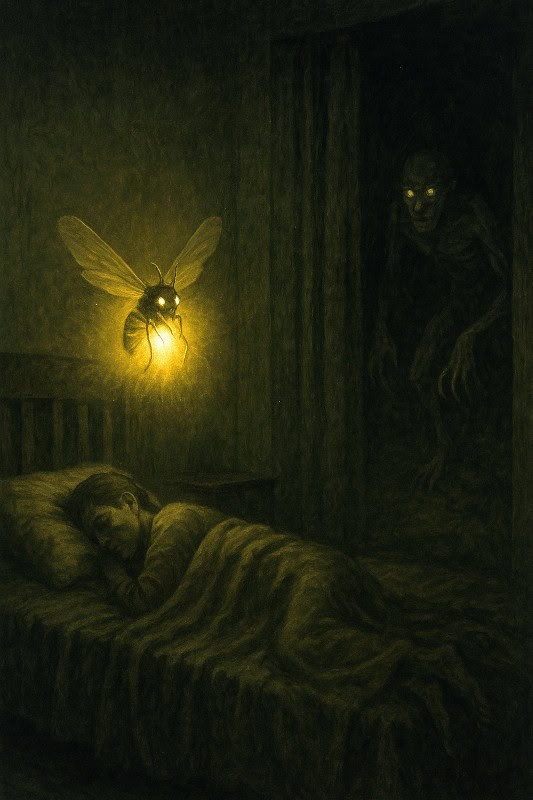
Among global mythology horror creatures, the Adze stands out as one of the most underestimated – and most insidious. Rooted in the Ewe folklore of Togo and Ghana, this vampiric spirit blends cunning with a hunger for human vitality. In its most deceptive form, it appears as an ordinary glowing firefly drifting harmlessly through the night, its beauty masking its deadliest trait.
The Adze slips through tiny cracks in windows and doors, unseen and unheard, landing softly on its sleeping victim’s skin. It pierces flesh with a proboscis-like mouth, drawing out not just blood, but the very essence of life. By morning, the victim wakes sickly and hollow-eyed. Over time, the Adze drains their energy and spirit until they grow weak and fade away – a slow death delivered by a nocturnal parasite.
In some traditions, the Adze is more than just a creature. It’s also the spirit form of a person suspected of witchcraft, blurring the line between folklore and fear-fueled accusation.
Why it haunts West Africa:
When captured, the Adze reveals its true form: a grotesque, shrivelled humanoid, hunched and with a visage twisted by hunger. Some accounts describe its eyes as glowing embers and its fingers like claws, perfectly suited for grasping at souls. The Adze is feared not just for its bite, but for its persistence. Once it fixates on a victim, it is said to return night after night until nothing remains but an empty shell.
In some accounts, it doesn’t just target individuals. It spreads the curse over entire families, infecting the home with sickness, despair, and dread. To many, the Adze is more than a pest; it’s an omen of death, a harbinger of misfortune, and a supernatural thief of life.
Other versions tell of the Adze taking human form to move unnoticed, often adopting the likeness of someone accused of witchcraft. In these stories, the Adze becomes a tool of suspicion as much as a predator, feeding on both physical vitality and the paranoia it leaves behind.
What makes it unforgettable is not its size or shape, but the subtle, creeping horror of its attack. There’s no monster roar, no violent lunge from the shadows – only a faint glow at your window and the quiet draining of your life.
Art inspiration:
Make some room in your sketchbook – the Adze is here to turn your art session into a mosquito-borne horror story.
- Tiny Terror:
Draw the Adze as an unnerving, oversized firefly, glowing faintly with sickly green or amber light. Give it eyes too human to ignore, and delicate wings tipped in red, as if stained with blood. - Transformation Horror:
Split the image – one half a harmless glowing insect, the other a grotesque, hunched humanoid. Add sharp digits, hollow cheeks, and glowing amber eyes. Let the forms melt into each other, caught mid-transformation like something out of a cursed nightmare. - Window Scene:
Picture a sleeping person bathed in moonlight. Outside the window, a faint glow flickers. In the glass’s reflection, show the Adze’s monstrous true form staring in. Stretch its shadow so it creeps across the bed or wall. - Soul Drain Aesthetic:
Show a person in bed or curled on the floor, twisted into an uncomfortable, inhuman pose. Their mouth hangs slightly open, face veined or greyed, as a mist or glowing trail flows from them toward the firefly’s light – like their very spirit is being siphoned away. - Dual Allegory:
Split the canvas in two – one side peaceful and dreamlike, the other side a nightmare. Show a home infected with despair: cracked walls, dying plants, and family members with glazed eyes. Let the Adze hover between the two halves, a grinning bridge between beauty and rot.
Nightmarchers – the ghostly guardians you don’t dare interrupt
Hawaiian Folklore’s Procession of Doom
Origins & lore:
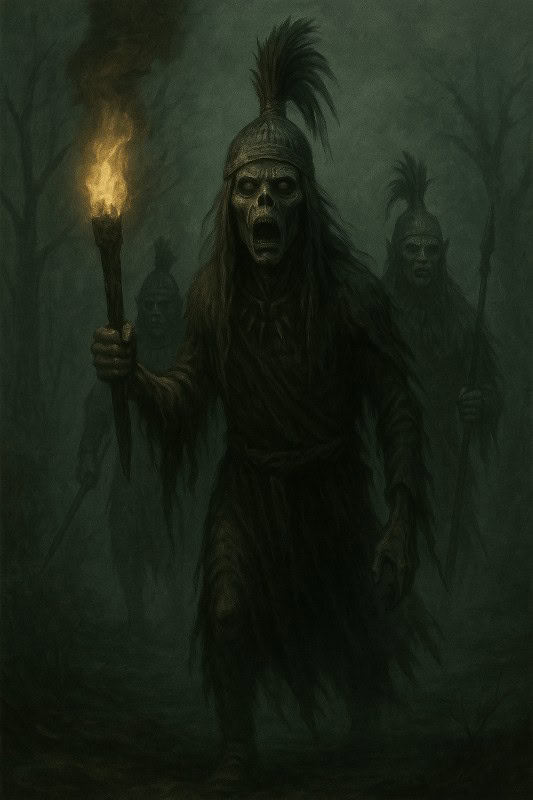
In Hawaiian mythology, Nightmarchers (huaka‘i pō) are the restless spirits of ancient warriors and chiefs doomed to roam the islands in eerie, torchlit processions. These aren’t ordinary ghosts – they’re powerful, sacred guardians of the old ways, carrying out their duties long after death. Their marches often take place at night, especially on sacred dates tied to Hawaiian lunar calendars, or near battlefields, temples, and ancient burial grounds.
The sight of a Nightmarcher procession is said to be both mesmerising and terrifying. Warriors clad in feathered cloaks and helmets, carrying spears and torches that burn with an unnatural light, all moving in perfect, silent unison. At their centre may walk a high-ranking chief or even a god, hidden from mortal eyes. Some tales whisper that gods themselves lead the march, their ranks cloaked in feathered capes, drumming through the veil between worlds.
Why they still haunt Hawaii:
Nightmarchers aren’t mindless phantoms or malevolent ghosts – they’re sacred spirits bound by duty. They walk the paths they once defended in life, guarding ancestral memory, land, and tradition. Their presence warns against defiling what should remain respected.
Their routes are sacred, and anyone who crosses them without showing proper respect faces instant, soul-deep consequences. Tradition says you must lie face down, avert your eyes, and stay completely still. Even hearing the distant drums or the faint blare of a conch shell means your fate may already be sealed. Stand, meet their gaze, or block their way, and your soul is ripped from your body.
Yet there’s mercy in their march. If you show reverence, the Nightmarchers may let you live – some even believe they’ll grant protection to those descended from their ranks. To the Nightmarchers, this isn’t haunting. It’s preserving. Their sacred duty is eternal.
Art inspiration:
Get your sketch on – the Nightmarchers are your only chance at drawing a ghostly conga line before it tramples you.
- Ghostly Procession:
Show a glowing line of warriors marching through mist and darkness, torches flickering with eternal light. Their feet hover just above the ground, casting long shadows without leaving footprints. Include feathered cloaks, traditional helmets, and intense expressions to capture their authority. - Eerie Atmosphere:
Add subtle environmental storytelling – bent grasses, extinguished flames, or startled birds taking flight. Trees lean as if bowing to the march, and shadows stretch unnaturally behind the warriors. - Respectful Horror:
Depict a lead Nightmarcher with ritual scars, a cracked battle-worn mask, and burning white eyes. Show him mid-step, his gaze fixed just beyond the viewer but still bound to the procession’s path. - Spectator’s Perspective:
Show a lone observer lying face down in the dirt, glowing torches passing silently overhead. The ghost pauses, looking directly at the viewer – expression unreadable. Is it mercy… or judgement? - Symbolic Composition:
Split the scene diagonally. On one side, a peaceful Hawaiian village under moonlight. On the other, Nightmarchers emerge from shadow, feet never touching the ground, the wind howling unnaturally as the veil between worlds thins.
La Viuda – the widow who waits… and hates
Chile’s Vengeful Spirit in a Mourning Veil
Origins & lore:
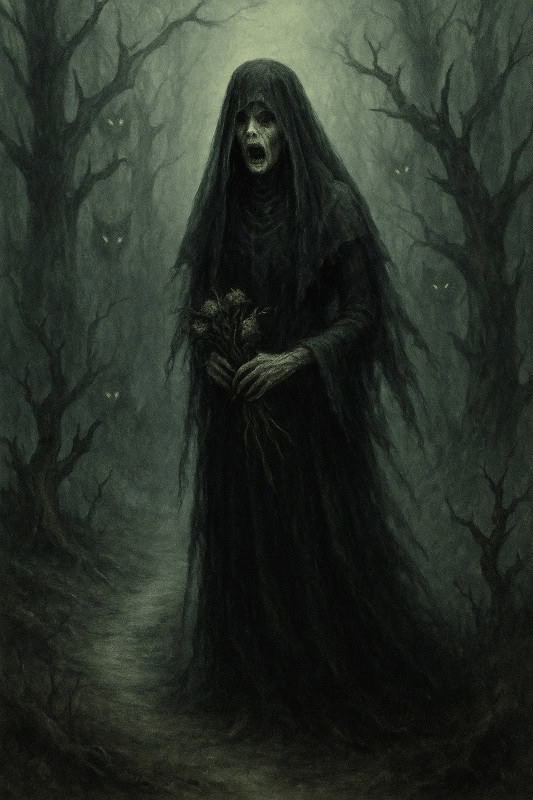
In South American folklore – especially Chilean legends – La Viuda (The Widow) is the ghost of a woman consumed by grief, betrayal, and rage. Some say she lost her beloved husband to another woman and died of heartbreak. Others claim she was murdered, her spirit left to wander the earth seeking revenge. In all tales, her sorrow curdled into hatred, and she rose again, shrouded in her long black morning veil, to punish the living.
La Viuda haunts lonely crossroads, quiet villages, and desolate paths after dark. Always cloaked in darkness, she moves with an unsettling grace, luring men closer with weeping sobs, pitiful cries, or seductive whispers. Those who draw near often meet a grisly end – some say she tears at their souls, others claim she leaves them lifeless on the roadside, their bodies twisted in terror.
Why she still haunts the land:
Her presence is strongest near cemeteries, funeral processions, and anywhere the veil between life and death feels thin. Witnesses report cold winds, the faint scent of earth and lilies, and the ominous sound of heels clicking on stone just before she appears.
Local warnings are clear: if you see a veiled woman walking alone at night, do not speak, do not follow – and whatever you do, never lift her veil.
La Viuda is grief turned monstrous – a reminder that betrayal, injustice, and cruelty can leave wounds that never heal. She chooses her targets: lecherous men, those who mock women’s suffering, and anyone who ignores the warnings. In some tales, she’s not evil at all, but cursed to wander, unable to let go of a love gone wrong.
She is more than a ghost – she’s sorrow wrapped in black lace, an unending cry for justice. Those who survive an encounter carry the memory like a brand: too raw to forget, too heavy to throw away.
Art inspiration:
Sharpen your pencils – La Viuda’s the only model who’ll insist on black-and-white… because she’s already planning your funeral.
- Veiled Terror:
Draw a looming silhouette in a shredded black veil. Her skeletal cheekbones and glowing eyes glint through layers of tattered lace. Her lips part in a silent snarl, hinting at the fury beneath. - Victorian Gothic Meets Folk Horror:
Mix old-world mourning garments (like corseted dresses and widow’s shawls) with dusty South American rural roads, empty fields, or crumbling grave markers. The scene should feel as forgotten as she is. - Symbolic Rage:
Show her lashing out at a figure surrounded by broken wedding rings, dead flowers, or cracked gravestones. Add subtle visual clues – photos burned at her feet, shadows of past betrayals flickering in the trees. - Grief Manifested:
Birds drop from the sky, funeral ribbons twist in unnatural wind, and cracked mirrors reflect only her eyes. Let sorrow paint the scene, with rage in every stroke. - Face the Fury:
Depict her mid-transformation – one side still human, quietly weeping; the other twisted with wrath, mouth open in a scream. Her veil whips unnaturally in the air as if pulled by the force of her anguish.
Conclusion: the world is a haunted house… and we’re just living in it
From snowy forests to jungle rivers, ancient battlefields to misty coastlines, every corner of the globe has whispered its own version of terror into the night. These myths aren’t just old ghost stories – they’re reflections of human fear, grief, greed, and mystery… the things that have always lurked just out of sight.
Whether you’re sketching the sorrow of La Viuda, the hunger of the Wendigo, the silent march of ancestral spirits, or the flicker of an Adze at your window, you’re tapping into a storytelling tradition older than time itself. Drawing global mythology horror creatures means channelling ancient fears that have haunted every culture.
Global mythology reminds us:
Fear speaks every language.
Grief wears every face.
And monsters?
Monsters are everywhere – waiting for you to bring them back to life on paper.
Want more mythological mayhem?
If you enjoyed this tour of terror through global legends, creep further with these eerie entries:
- Greek, Norse & Other Classical Horrors
Where gods, monsters, and ancient epics get the horror treatment they deserve. - Yokai & Japanese Spirits: Creepy Muse Fuel for Horror Art
From beaked trickster Tengu to cursed umbrellas, it’s folklore with a chilling twist.