
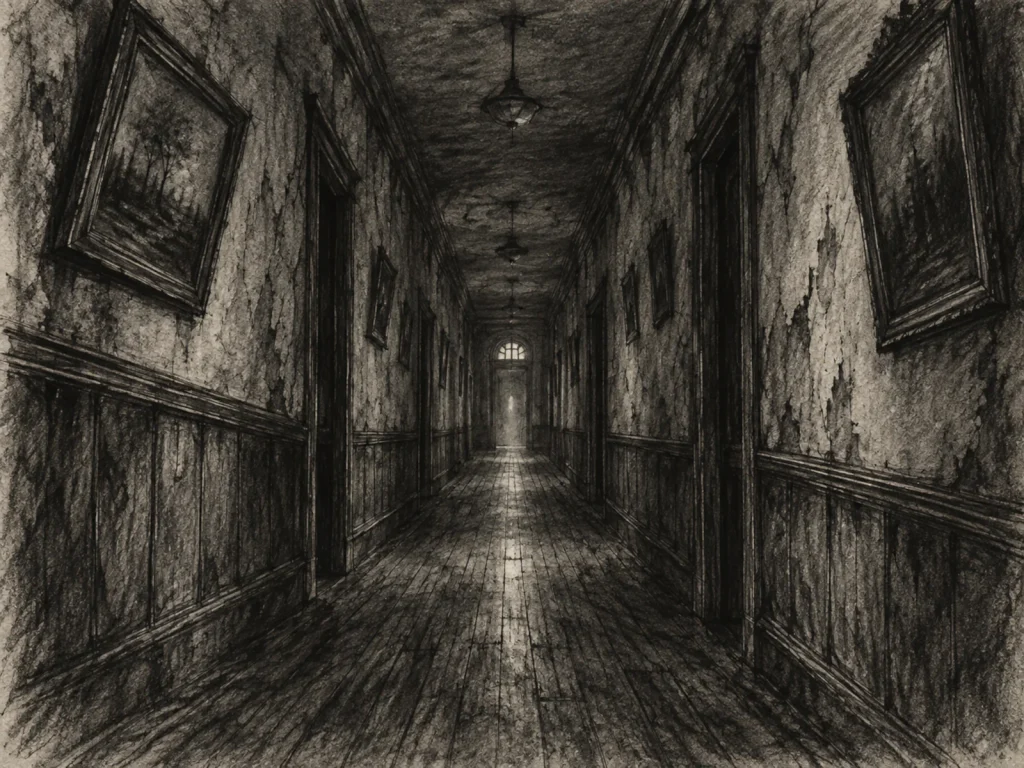
Perspective in drawing is what gives flat shapes a sense of depth, distance and believable space. It helps you place characters, objects and environments so they feel grounded within a scene rather than floating separately from one another.
For horror art, perspective can do even more. A low viewpoint can make a figure feel imposing, a long corridor can pull the viewer deeper into a scene, and distorted angles can make familiar spaces feel unsettling. Understanding the fundamentals gives you the control to create realistic depth when you need it – and bend those rules deliberately when the artwork calls for something stranger.
This hub brings together guides covering horizon lines, vanishing points, one-point, two-point and three-point perspective, atmospheric depth and perspective techniques for horror artwork. Whether you’re building an eerie interior, a looming structure or a scene that feels deliberately warped, these guides will help you understand how space works on the page and use it with more confidence.
Explore the sections below to start building stronger, more convincing scenes – then push them as far into the dark as you like.
Understanding the Basics of Perspective
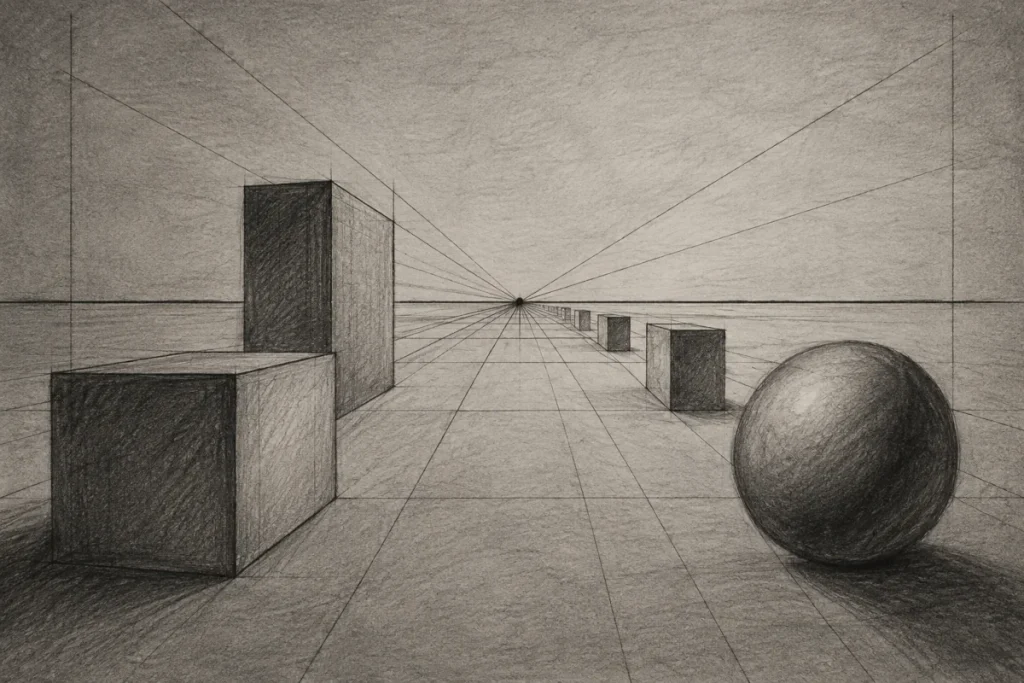
Before getting into one-point, two-point and more advanced perspective, it helps to understand the few ideas everything else is built on. Perspective works through the relationship between your viewpoint, the horizon line and vanishing points, giving you a framework for placing objects convincingly in three-dimensional space.
Start with these three guides:
- What is Perspective in Drawing? Understanding Depth, Space, and Realism
Learn what perspective actually does, why it matters and how it creates the illusion of depth on a flat page. - What is a Horizon Line in Drawing? Understanding Eye Level and Viewpoint
Explore how the horizon line relates to the viewer’s eye level and how changing it can completely alter the way a scene feels. - What are Vanishing Points in Drawing? Understanding Depth and Direction
Understand how vanishing points control the direction of receding lines and help objects sit naturally within the same space.
These three fundamentals form the foundation for almost every perspective technique that follows. Once they start to make sense, one-point, two-point and three-point perspective become much easier to understand rather than feeling like a collection of mysterious lines disappearing across the page.
Types of Perspective and How to Use Them
Perspective isn’t one single technique. Different approaches change how much of a scene we can see, how strongly forms recede into space and how dramatic the final composition feels. Choosing the right type of perspective can completely change the mood and scale of a drawing.
This section will eventually explore the main perspective methods individually, including how they work, when to use them and how they can be adapted for darker artwork.
- One-Point Perspective – Using a single vanishing point to create depth in corridors, roads, rooms and other scenes viewed primarily from the front.
- Two-Point Perspective – Building convincing corners, buildings, objects and environments using two vanishing points.
- Three-Point Perspective – Adding a third vanishing point for steep viewpoints, towering structures and more dramatic angles.
- Curvilinear Perspective – Creating wide, distorted views where straight forms appear to curve across the scene.
- Atmospheric Perspective – Using changes in contrast, detail and value to make distant elements appear further away.
- Perspective for Horror Art – Using unusual viewpoints, exaggerated depth and controlled distortion to make otherwise familiar spaces feel unsettling.
Each guide will break the technique down individually, so you can understand the structure first and then decide how closely you want to follow – or deliberately distort – it.
Practical Perspective Applications
Understanding perspective is one thing. Getting comfortable using it comes from actually drawing with it – testing different viewpoints, building simple forms in space and gradually working up to more complicated scenes.
This section will bring together practical guides designed to help you apply perspective rather than just understand the theory behind it. The exercises will focus on building confidence, spotting problems and making corrections before perspective starts quietly dismantling the entire drawing.
- Step-by-Step Perspective Drawing Exercises – Structured exercises for practising depth, vanishing points and spatial construction.
- How to Keep Proportions Consistent in Perspective – Techniques for keeping objects and figures believable as they move closer to or further from the viewer.
- Common Perspective Drawing Mistakes and How to Fix Them – How to recognise awkward angles, inconsistent scale and other problems before they take over the scene.
These practical guides will give you somewhere to put the fundamentals into action, building the habits that make perspective feel increasingly natural over time.
Using Perspective with Confidence
Perspective gives you control over how depth, scale and space are experienced within a drawing. Once you understand the underlying structure, you can create scenes that feel convincing – or deliberately push them away from reality when you want something more unsettling.
For horror artwork especially, that control can be incredibly useful. A carefully chosen viewpoint, exaggerated angle or distorted sense of distance can change the entire atmosphere of a scene. The strongest distortions usually work because there is still an understanding of believable perspective underneath them.
As more guides are added to this hub, you’ll be able to explore each technique in greater depth and practise applying it to different subjects and environments.
Learn the structure, build confidence with it, and then decide exactly how far you want to bend the rules.
